Showing posts with label creation. Show all posts
Showing posts with label creation. Show all posts
Thursday, August 11, 2011


Monday, August 8, 2011
Friday, August 5, 2011
Incredible Creatures That Defy Evolution
"For since the creation of the world, God's invisible qualities--his eternal power and divine nature--have been clearly seen, being understood from what has been made, so that men are without excuse." (Romans 1:20)
Tuesday, August 2, 2011
Friday, July 29, 2011
Monday, November 17, 2008
Quotes regarding Creation
"I can see how it might be possible for a man to look down upon earth and be an atheist, but I cannot conceive how he could look up into the heavens and say there is no God.”
(Abraham Lincoln)
"The visible order of the universe proclaims a supreme intelligence."
(Jean-Jacques Rousseau)
"Science brings men nearer to God."
(Louis Pasteur)
"The visible marks of extraordinary wisdom and power appear so plainly in all the works of the creation that a rational creature, who will but seriously reflect on them, cannot miss the discovery of a Deity."
(John Locke)
"As a house implies a builder, and a garment a weaver, and a door a carpenter, so does the existence of the Universe imply a Creator."
(Marquis de Vauvenargues)
"It is impossible to account for the creation of the universe without the agency of a Supreme Being."
(George Washington)
"Of what I call God, And fools call Nature."
(Robert Browning)
"So irresistible are these evidences of an intelligent and powerful Agent that, of the infinite numbers of men who have exited thro' all the time, they have believed, in the proportion of a million at least to Unit, in the hypotheses of an eternal pre-existence of a creator, rather than in that of a self-existent Universe."
(Thomas Jefferson)
"Nature is the art of God."
(Dante Alighieri)
"The more I study nature, the more I stand amazed at the work of the Creator."
(Louis Pasteur)
(Also see my past blog articles on Creation)
(Abraham Lincoln)
"The visible order of the universe proclaims a supreme intelligence."
(Jean-Jacques Rousseau)
"Science brings men nearer to God."
(Louis Pasteur)
"The visible marks of extraordinary wisdom and power appear so plainly in all the works of the creation that a rational creature, who will but seriously reflect on them, cannot miss the discovery of a Deity."
(John Locke)
"As a house implies a builder, and a garment a weaver, and a door a carpenter, so does the existence of the Universe imply a Creator."
(Marquis de Vauvenargues)
"It is impossible to account for the creation of the universe without the agency of a Supreme Being."
(George Washington)
"Of what I call God, And fools call Nature."
(Robert Browning)
"So irresistible are these evidences of an intelligent and powerful Agent that, of the infinite numbers of men who have exited thro' all the time, they have believed, in the proportion of a million at least to Unit, in the hypotheses of an eternal pre-existence of a creator, rather than in that of a self-existent Universe."
(Thomas Jefferson)
"Nature is the art of God."
(Dante Alighieri)
"The more I study nature, the more I stand amazed at the work of the Creator."
(Louis Pasteur)
(Also see my past blog articles on Creation)
Thursday, October 30, 2008
If Evolution, then moral freedom
"Evolutionary ideas fueled Hitler's Nazism and Stalin's communism," said CSI director Tom DeRosa. "Today, its consequences are evident in our society's lawlessness and immorality. No Creator means no accountability for our actions."
Closing the door on the existence of God liberates man, DeRosa said, to become his own master and lawgiver. Darwin himself acknowledged this. "A man who has no assured and ever-resent belief in the existence of a personal God ... can have for his rule of life, as far as I can see, only to follow those impulses and instincts which are the strongest or which seem to him the best ones."
(from "Impact," April 2008)
If Darwinian Evolution is true, then there is no foundation for ethics, and no ultimate meaning in life.
Closing the door on the existence of God liberates man, DeRosa said, to become his own master and lawgiver. Darwin himself acknowledged this. "A man who has no assured and ever-resent belief in the existence of a personal God ... can have for his rule of life, as far as I can see, only to follow those impulses and instincts which are the strongest or which seem to him the best ones."
(from "Impact," April 2008)
If Darwinian Evolution is true, then there is no foundation for ethics, and no ultimate meaning in life.
Wednesday, October 29, 2008
Teachers expelled for presenting more than one view
"Iowa State University denied tenure to astronomy professor Guillermo Gonzalez last year, despite having scientific and academic credentials that surpassed many of his colleagues. The reason, based on statements made by Gonzalez' fellow faculty members, is his support for the view that Intelligent Design best explains the remarkable way in which physical laws are "fine-tuned" to support complex life."
"In 2005, biology professor Caroline Crocker was let go from George Mason University where, in her classes, she "decided to put all references to evolution into one one lecture and ... give the evidence for and against evolution," Crocker said in a Coral Ridge Hour interview. When the class was finished, Crocker made this final remark about origins: "Is it evolution, Intelligent Design, or Creation? think about it.
Unfortunately, Crocker's actions landed her in her supervisor's office. She was banned from lecturing and filed a grievance to protest the decision. At the end of the semester, GMU allowed her contract to expire.
"Censoring professors and students who air alternative views to evolution goes against the idea that a good education consists of providing arguments from all sides," said Brian Fisher, President of Coral Ridge Ministries."
"Evolutionists today have absolutely a fit at the very thought of both sides of the origins debate being presented in school. They want evolution alone taught — and dogmatically at that. They think it is terrible that anyone would suggest such a thing as presenting both sides.
However, one writer said, "A fair result can be obtained only by fully stating and balancing the facts and arguments on both sides of each question..." To present both sides of this argument is the only way, he said, to come to a "fair result."
Obviously, one would think it was some sort of fanatical Christian who made that statement. No. As a matter of fact, it is found in Charles Darwin's The Origin of Species. But that has been conveniently forgotten in our time.
(from "Impact," April 2008)
"In 2005, biology professor Caroline Crocker was let go from George Mason University where, in her classes, she "decided to put all references to evolution into one one lecture and ... give the evidence for and against evolution," Crocker said in a Coral Ridge Hour interview. When the class was finished, Crocker made this final remark about origins: "Is it evolution, Intelligent Design, or Creation? think about it.
Unfortunately, Crocker's actions landed her in her supervisor's office. She was banned from lecturing and filed a grievance to protest the decision. At the end of the semester, GMU allowed her contract to expire.
"Censoring professors and students who air alternative views to evolution goes against the idea that a good education consists of providing arguments from all sides," said Brian Fisher, President of Coral Ridge Ministries."
"Evolutionists today have absolutely a fit at the very thought of both sides of the origins debate being presented in school. They want evolution alone taught — and dogmatically at that. They think it is terrible that anyone would suggest such a thing as presenting both sides.
However, one writer said, "A fair result can be obtained only by fully stating and balancing the facts and arguments on both sides of each question..." To present both sides of this argument is the only way, he said, to come to a "fair result."
Obviously, one would think it was some sort of fanatical Christian who made that statement. No. As a matter of fact, it is found in Charles Darwin's The Origin of Species. But that has been conveniently forgotten in our time.
(from "Impact," April 2008)
Thursday, September 25, 2008
Could God Have Used Evolution?
Sean McDowell
(The following article is from Christian Worldview Network
“Why couldn’t God have just used evolution as his means of creating the world? Why do many Christians consider it a threat to their faith? What’s the big deal?” This is one of the most commonly asked questions about the origins debate, especially from young people. Many people wonder why Christians don’t simply accept Darwin’s theory as the means through which God created and then get on with it.
This is a question I have wrestled with quite profoundly. I have asked many theologians, scientists, and philosophers the question, Is Darwinian evolution compatible with Christianity? After much thought and research, the conclusion I have come up with is that they are not compatible. To accept Darwinian evolution would be a grave mistake. Let me explain.
Christianity and Darwinian Evolution: An Oxymoron!
The reason the two cannot be wedded together is actually rather simple: Darwinian evolution (as you may recall from 9th grade Biology class) is a blind, undirected, purposelessness process. As Richard Dawkins regularly points out, evolution is a chance process that has no end-goal in mind. On the other hand, when we design something it’s no longer blind and it’s no longer undirected—it’s purposeful. Thus, to say God used evolution is an oxymoron (designed-chance) like “Christian-atheist,” “jumbo-shrimp,” or “Microsoft Works.”
Think about it this way. There are two ways to build a computer (which, by the way, is far less complex than a single human cell). One option is to throw the parts on the ground and let natural processes alone do the work. Maybe with wind, rain, and a big earthquake the computer will be assembled by itself. If so, this would be a chance process. Most reasonable people will recognize that this will never happen, but it does illustrate how something could in principle be constructed by chance (ignoring the question of where the parts came from in the first place!)
But there is another way to build a computer: design. A computer designer makes individual parts and places them in the right arrangement so it will perform certain functions. A computer designer has a purposeful, directed plan for the computer—it is not the result of chance.
Can you see how this relates to evolution? God could either design the world or let it go by chance, but not both. As soon as God guides the process (design) it is no longer natural (chance). It is simply illogical to claim that God used evolution as his means of creating the world, for it would be an oxymoron: designed-chance.
Now, if by “evolution” we simply mean common descent, then sure—God could’ve used common descent. Common descent refers to the idea that all species are derived from a common ancestor millions of years ago (i.e., you are related to your pet snail!). God could have created all organisms with a common ancestor. But here’s the key point: His mechanism would not be natural selection acting on random mutation, for that is an un-designed process.
Consider Corvettes as an example. Corvettes have a common ancestor (the first year they were made). As Corvettes are designed over multiple years, we see similarities and commonalities with each successive model. But, of course, Corvettes were designed. If that’s what we mean by evolution, then sure, God could’ve used it. Many proponents of intelligent design actually believe this (for the record, I don’t).
Can Christians Believe in Evolution?
So, can someone be a Christian and believe in evolution? Sure. You can be a Christian and believe in all sorts of things that are false! But the real question is, Can Christianity be true and Darwinian evolution be true? I don’t think they can.
I think a lot of people want to find a way to reconcile the two because they believe the evidence for Darwinian evolution is so overwhelming that they want to “save room” for their faith by saying maybe God just used evolution. So, they want to maintain their faith without giving it up. But as I write in Understanding Intelligent Design (Harvest House, 2008), you don’t have to! There’s another scientifically and philosophically rigorous theory that is much more compatible with the historic Christian faith. You can check out the first chapter for free at www.seanmcdowell.org.
Distributed by www.ChristianWorldviewNetwork.com
(To see the article on its original website, go HERE
(The following article is from Christian Worldview Network
“Why couldn’t God have just used evolution as his means of creating the world? Why do many Christians consider it a threat to their faith? What’s the big deal?” This is one of the most commonly asked questions about the origins debate, especially from young people. Many people wonder why Christians don’t simply accept Darwin’s theory as the means through which God created and then get on with it.
This is a question I have wrestled with quite profoundly. I have asked many theologians, scientists, and philosophers the question, Is Darwinian evolution compatible with Christianity? After much thought and research, the conclusion I have come up with is that they are not compatible. To accept Darwinian evolution would be a grave mistake. Let me explain.
Christianity and Darwinian Evolution: An Oxymoron!
The reason the two cannot be wedded together is actually rather simple: Darwinian evolution (as you may recall from 9th grade Biology class) is a blind, undirected, purposelessness process. As Richard Dawkins regularly points out, evolution is a chance process that has no end-goal in mind. On the other hand, when we design something it’s no longer blind and it’s no longer undirected—it’s purposeful. Thus, to say God used evolution is an oxymoron (designed-chance) like “Christian-atheist,” “jumbo-shrimp,” or “Microsoft Works.”
Think about it this way. There are two ways to build a computer (which, by the way, is far less complex than a single human cell). One option is to throw the parts on the ground and let natural processes alone do the work. Maybe with wind, rain, and a big earthquake the computer will be assembled by itself. If so, this would be a chance process. Most reasonable people will recognize that this will never happen, but it does illustrate how something could in principle be constructed by chance (ignoring the question of where the parts came from in the first place!)
But there is another way to build a computer: design. A computer designer makes individual parts and places them in the right arrangement so it will perform certain functions. A computer designer has a purposeful, directed plan for the computer—it is not the result of chance.
Can you see how this relates to evolution? God could either design the world or let it go by chance, but not both. As soon as God guides the process (design) it is no longer natural (chance). It is simply illogical to claim that God used evolution as his means of creating the world, for it would be an oxymoron: designed-chance.
Now, if by “evolution” we simply mean common descent, then sure—God could’ve used common descent. Common descent refers to the idea that all species are derived from a common ancestor millions of years ago (i.e., you are related to your pet snail!). God could have created all organisms with a common ancestor. But here’s the key point: His mechanism would not be natural selection acting on random mutation, for that is an un-designed process.
Consider Corvettes as an example. Corvettes have a common ancestor (the first year they were made). As Corvettes are designed over multiple years, we see similarities and commonalities with each successive model. But, of course, Corvettes were designed. If that’s what we mean by evolution, then sure, God could’ve used it. Many proponents of intelligent design actually believe this (for the record, I don’t).
Can Christians Believe in Evolution?
So, can someone be a Christian and believe in evolution? Sure. You can be a Christian and believe in all sorts of things that are false! But the real question is, Can Christianity be true and Darwinian evolution be true? I don’t think they can.
I think a lot of people want to find a way to reconcile the two because they believe the evidence for Darwinian evolution is so overwhelming that they want to “save room” for their faith by saying maybe God just used evolution. So, they want to maintain their faith without giving it up. But as I write in Understanding Intelligent Design (Harvest House, 2008), you don’t have to! There’s another scientifically and philosophically rigorous theory that is much more compatible with the historic Christian faith. You can check out the first chapter for free at www.seanmcdowell.org.
Distributed by www.ChristianWorldviewNetwork.com
(To see the article on its original website, go HERE
Wednesday, September 24, 2008
Evolution quotes and frauds
"...as I became exposed to the law and order of the universe, I was
literally humbled by its unerring perfection. I became convinced that
there must be a divine intent behind it all... My experiences with science led me to God. They challenge science to prove the existence of God. But must we really light a candle to see the sun?"
--Dr. Wernher von Braun.
"Curious as that seems, it is a possibility worth weighing — against the only alternative I can imagine: Eddington's suggestion that God is a mathematical physicist." — George Wald, "Fitness in the Universe," Origins of Life, Vol. 5 (1974), p. 26.
“The missing link between man and the apes…is merely the most glamorous of a whole hierarchy of phantom creatures. In the fossil record, missing links are the rule: the story of life is as disjointed as a silent newsreel, in which species succeed one another as abruptly as Balkan prime ministers. The more scientists have searched for the transitional forms between species, the more they have been frustrated… Evidence from fossils now points overwhelmingly away from the classical Darwinism which most Americans learned in high school…” [Newsweek, Is Man a Subtle Accident? Nov. 3, 1980 p. 95.]
“One wonders why, with all the evidence, the (Godless) theory of evolution still persists. One major reason is that many people have a sort of vested interest in this theory. Jobs would be lost, loss of face would result, text books would need to be eliminated or revised.” (Dr. Emery S. Dunfee, former professor of physics at the University of Maine at Farmington)
“Polls have shown that about 40% of scientists acknowledge a supernatural power. But the majority of the scientific community, especially evolutionary leaders today, hold an atheistic worldview. As support for their anti-supernatural worldviews, these scientists need mechanisms for the origin of life, especially humans.
Atheism needs evolution to escape from any implications regarding a creator.
If one starts with Darwinism, certainly it is easy to escape from any obligation to God. Those opposed to their reasoning are branded as obscurantists who are trying to intrude religion into science.”
(Wayne Friar, Ph.D., AIA’s Resource Associate for Science and Origins)
“I shall discuss the broad patterns of hominoid evolution, an exercise made enjoyable by the need to integrate diverse kinds of information, and use that as a vehicle to speculate about hominid origins, an event for which there is no recognized fossil record. Hence, an opportunity to exercise some imagination.” [American Anthropologist, Distinguished Lecture; Hominoid Evolution and Hominoid Origins, by David Pilbeam. Vol. 88, No. 2 June 1986. p. 295.]
“Question is: Can you tell me anything you know about evolution, any one thing that is true? I tried this question on the geology staff at the Field Museum of Natural History and the only answer I got was silence. - - Then I woke up and realized that all my life I had been duped into taking evolutionism as revealed truth in some way.” Dr. Colin Patterson, Evolution and Creationism, Speech at the American Museum of Natural History, New York (November 5, 1981), pp. 1,2. Dr. Patterson is senior paleontologist at the British Museum of Natural History and editor of its journal, as well as author of the book Evolution.
“A scientific study of the universe has suggested a conclusion which may be summed up in the statement that the universe appears to have been designed by a pure mathematician.” — Sir James Jeans, The Mysterious Universe, p. 140.
Consider a famous Neanderthal fossil discovered in a peat bog near Hamburg, Germany, dated by Professor Reiner Protsch. On February 18, 2005, Protsch was forced to retire in disgrace after a Frankfurt University panel ruled he had “fabricated data and plagiarized the work of his colleagues.” Once believed to be a world-renowned expert on carbon dating, Protsch’s entire professional career is now being questioned. The university noted: “The commission finds that Prof. Protsch has forged and manipulated scientific facts over the past 30 years.”
Protsch’s work first attracted suspicion when scientists at Oxford wanted to double-check the authenticity of his dates and verify the ages of many previously reported fossils using modern techniques. Oxford officials insist that this “dating disaster” was discovered during a routine examination, and was not an attempt to discredit Professor Protsch. The fossils he had dated were just in a long line of others that were being rechecked. According to Thomas Terberger, the archaeologist who discovered the hoax: “[A]nthropology is going to have to completely revise its picture of modern man between 40,000 and 10,000 years ago” (as quoted in Harding, 2005).
But the Neanderthal skull was not the only forgery Oxford discovered. Protsch also had paraded “Binshof-Speyer” woman before the public, stating that she was 21,300 years old. Yet the new Oxford date puts this woman living at 1,300 B.C. Protsch also claimed that “Paderborn-Sande Man” walked the Earth 27,400 B.C., and yet the corrected figure reveals that he died only a couple hundred years ago—in A.D. 1750! Futhermore, Protsch also is being investigated for a scandal in which he allegedly tried to sell 280 chimpanzee skulls to individuals in the United States for $70,000.
(The above from: http://www.apologeticspress.org/articles/2711)
As far as the excuse that this is how Science works—that Science is self-correcting—how many times will pre-history have to be re-written, and how many millions of people have been deceived by this and other lies sold to the public as ‘major pieces of evidence?’ (i.e., the many other hoaxes such as Piltdown Man, Nebraska Man, Lucy, Heidelberg Man, Peking Man, New Guinea Man, Cro-Magnon Man, Java Man, Ramapithecus, Orce Man, Archaeoraptor Liaoningensis, etc.)
Another example:
National Geographic published an article on Archaeoraptor in 1999. And yet, Archaeoraptor was a fraud. It was concluded that the fossil was a composite specimen of at least 3 specimens, with a maximum of five separate specimens.
Here is yet another case where Evolutionists have claimed evidence which has later turned out to be false:
"In July 2002, anthropologists announced the discovery of a skull in Chad with "an unusual mixture of primitive and humanlike features." The find was dubbed "Toumai" (the name give to children in Chad born close to the dry season) and was immediately hailed as "the earliest member of the human family found so far." By October 2002, a number of scientists went on record to criticize the premature claim -- declaring that the discovery is merely the fossil of an ape."
from: http://www.allaboutcreation.org/human-evolution.htm
To call this the "scientific process" is dishonest, because, according to Wikipedia, the 'scientific method' means that the "steps must be repeatable in order to predict dependably any future results."
http://en.wikipedia.org/wiki/Scientific_method
Even calling 'Evolution' a 'theory' is not strictly accurate, because "a theory is a systematic and formalized expression of all previous observations, and is predictive, logical, and testable."
http://en.wikipedia.org/wiki/Theory#Science
The origin of the universe is not repeatable. And evolution of new species is not observable. Therefore, neither one can be proved or disproved by the scientific method; this means that Evolution is a philosophy rather than true Science.
Also check these out:
"Just when you think Evolutionists couldn't be any more confused about the origins of Humanity, they go and prove you wrong. According to the Evolutionist's Aquatic Ape Theory (AAT) we all came from apes that lived underwater, much like the Sea-Monkeys seen in the back of old Archie comic books."
See: http://objectiveministries.org/creation/aquatic.html
Evolutionists Claim Nessie Is An Elephant
Unexplained sightings of the Loch Ness monster could have been elephants enjoying a swim, a scientist has said.
See: http://news.bbc.co.uk/2/hi/uk_news/scotland/4779248.stm
literally humbled by its unerring perfection. I became convinced that
there must be a divine intent behind it all... My experiences with science led me to God. They challenge science to prove the existence of God. But must we really light a candle to see the sun?"
--Dr. Wernher von Braun.
"Curious as that seems, it is a possibility worth weighing — against the only alternative I can imagine: Eddington's suggestion that God is a mathematical physicist." — George Wald, "Fitness in the Universe," Origins of Life, Vol. 5 (1974), p. 26.
“The missing link between man and the apes…is merely the most glamorous of a whole hierarchy of phantom creatures. In the fossil record, missing links are the rule: the story of life is as disjointed as a silent newsreel, in which species succeed one another as abruptly as Balkan prime ministers. The more scientists have searched for the transitional forms between species, the more they have been frustrated… Evidence from fossils now points overwhelmingly away from the classical Darwinism which most Americans learned in high school…” [Newsweek, Is Man a Subtle Accident? Nov. 3, 1980 p. 95.]
“One wonders why, with all the evidence, the (Godless) theory of evolution still persists. One major reason is that many people have a sort of vested interest in this theory. Jobs would be lost, loss of face would result, text books would need to be eliminated or revised.” (Dr. Emery S. Dunfee, former professor of physics at the University of Maine at Farmington)
“Polls have shown that about 40% of scientists acknowledge a supernatural power. But the majority of the scientific community, especially evolutionary leaders today, hold an atheistic worldview. As support for their anti-supernatural worldviews, these scientists need mechanisms for the origin of life, especially humans.
Atheism needs evolution to escape from any implications regarding a creator.
If one starts with Darwinism, certainly it is easy to escape from any obligation to God. Those opposed to their reasoning are branded as obscurantists who are trying to intrude religion into science.”
(Wayne Friar, Ph.D., AIA’s Resource Associate for Science and Origins)
“I shall discuss the broad patterns of hominoid evolution, an exercise made enjoyable by the need to integrate diverse kinds of information, and use that as a vehicle to speculate about hominid origins, an event for which there is no recognized fossil record. Hence, an opportunity to exercise some imagination.” [American Anthropologist, Distinguished Lecture; Hominoid Evolution and Hominoid Origins, by David Pilbeam. Vol. 88, No. 2 June 1986. p. 295.]
“Question is: Can you tell me anything you know about evolution, any one thing that is true? I tried this question on the geology staff at the Field Museum of Natural History and the only answer I got was silence. - - Then I woke up and realized that all my life I had been duped into taking evolutionism as revealed truth in some way.” Dr. Colin Patterson, Evolution and Creationism, Speech at the American Museum of Natural History, New York (November 5, 1981), pp. 1,2. Dr. Patterson is senior paleontologist at the British Museum of Natural History and editor of its journal, as well as author of the book Evolution.
“A scientific study of the universe has suggested a conclusion which may be summed up in the statement that the universe appears to have been designed by a pure mathematician.” — Sir James Jeans, The Mysterious Universe, p. 140.
Consider a famous Neanderthal fossil discovered in a peat bog near Hamburg, Germany, dated by Professor Reiner Protsch. On February 18, 2005, Protsch was forced to retire in disgrace after a Frankfurt University panel ruled he had “fabricated data and plagiarized the work of his colleagues.” Once believed to be a world-renowned expert on carbon dating, Protsch’s entire professional career is now being questioned. The university noted: “The commission finds that Prof. Protsch has forged and manipulated scientific facts over the past 30 years.”
Protsch’s work first attracted suspicion when scientists at Oxford wanted to double-check the authenticity of his dates and verify the ages of many previously reported fossils using modern techniques. Oxford officials insist that this “dating disaster” was discovered during a routine examination, and was not an attempt to discredit Professor Protsch. The fossils he had dated were just in a long line of others that were being rechecked. According to Thomas Terberger, the archaeologist who discovered the hoax: “[A]nthropology is going to have to completely revise its picture of modern man between 40,000 and 10,000 years ago” (as quoted in Harding, 2005).
But the Neanderthal skull was not the only forgery Oxford discovered. Protsch also had paraded “Binshof-Speyer” woman before the public, stating that she was 21,300 years old. Yet the new Oxford date puts this woman living at 1,300 B.C. Protsch also claimed that “Paderborn-Sande Man” walked the Earth 27,400 B.C., and yet the corrected figure reveals that he died only a couple hundred years ago—in A.D. 1750! Futhermore, Protsch also is being investigated for a scandal in which he allegedly tried to sell 280 chimpanzee skulls to individuals in the United States for $70,000.
(The above from: http://www.apologeticspress.org/articles/2711)
As far as the excuse that this is how Science works—that Science is self-correcting—how many times will pre-history have to be re-written, and how many millions of people have been deceived by this and other lies sold to the public as ‘major pieces of evidence?’ (i.e., the many other hoaxes such as Piltdown Man, Nebraska Man, Lucy, Heidelberg Man, Peking Man, New Guinea Man, Cro-Magnon Man, Java Man, Ramapithecus, Orce Man, Archaeoraptor Liaoningensis, etc.)
Another example:
National Geographic published an article on Archaeoraptor in 1999. And yet, Archaeoraptor was a fraud. It was concluded that the fossil was a composite specimen of at least 3 specimens, with a maximum of five separate specimens.
Here is yet another case where Evolutionists have claimed evidence which has later turned out to be false:
"In July 2002, anthropologists announced the discovery of a skull in Chad with "an unusual mixture of primitive and humanlike features." The find was dubbed "Toumai" (the name give to children in Chad born close to the dry season) and was immediately hailed as "the earliest member of the human family found so far." By October 2002, a number of scientists went on record to criticize the premature claim -- declaring that the discovery is merely the fossil of an ape."
from: http://www.allaboutcreation.org/human-evolution.htm
To call this the "scientific process" is dishonest, because, according to Wikipedia, the 'scientific method' means that the "steps must be repeatable in order to predict dependably any future results."
http://en.wikipedia.org/wiki/Scientific_method
Even calling 'Evolution' a 'theory' is not strictly accurate, because "a theory is a systematic and formalized expression of all previous observations, and is predictive, logical, and testable."
http://en.wikipedia.org/wiki/Theory#Science
The origin of the universe is not repeatable. And evolution of new species is not observable. Therefore, neither one can be proved or disproved by the scientific method; this means that Evolution is a philosophy rather than true Science.
Also check these out:
"Just when you think Evolutionists couldn't be any more confused about the origins of Humanity, they go and prove you wrong. According to the Evolutionist's Aquatic Ape Theory (AAT) we all came from apes that lived underwater, much like the Sea-Monkeys seen in the back of old Archie comic books."
See: http://objectiveministries.org/creation/aquatic.html
Evolutionists Claim Nessie Is An Elephant
Unexplained sightings of the Loch Ness monster could have been elephants enjoying a swim, a scientist has said.
See: http://news.bbc.co.uk/2/hi/uk_news/scotland/4779248.stm
Friday, April 25, 2008
Days and years in Genesis
Many people today discount the lifespans of those listed in Genesis, saying that its impossible that people actually lived that long. However, if the years in Genesis 5 are really shorter concerning men’s ages, then the days in Genesis 1 and 2 must be shorter as well, concerning the Creation account. Contrarily, if the days in Genesis 1 and 2 are actually thousands or millions of years, then the years of men’s ages in Genesis 5 must be thousands or millions of years!
Other ancient genealogies other than the Bible show long lifespans as well, during that time. The Sumerian Kings list mentions 3 kings that are said to have reigned 72,000 years each. Now, that is obviously exaggerated, but that very exaggeration makes more sense if people did live long lifespans back then. If they merely lived 70 or so years, such an exaggeration would make far less sense.
Genesis 7:4 says, “Seven days from now I will send rain on the earth for forty days and forty nights, and I will wipe from the face of the earth every living creature I have made.” If days were actually thousands or millions of years in Genesis, then it must have rained without letup for millions of years! That would mean that Noah was afloat in the ark with the animals for millions of years! On the other hand, if a 900 year genealogy is actually more like 90 years, then 40 days and 40 nights must only be a few minutes or less. This would mean that God flooded the entire world in just a few minutes!
Gen. 8:3,4 says, “The water receded steadily from the earth. At the end of the hundred and fifty days the water had gone down, and on the seventeenth day of the seventh month the ark came to rest on the mountains of Ararat.” How could they be so precise and exact with time periods HERE, yet be so imprecise when reporting people’s ages, or the days of Creation, in earlier chapters? In other chapters, very exact measurements are given, as well. It’s ridiculous to think that they could be so particular and exact with dates, measures, etc., yet be so imprecise and inaccurate when notating the number of years that people lived, or how long the period of Creation took.
If the recorded ages of some of the people in Genesis reflects a longer span than the years they actually lived (i.e., Adam lived 930 years; Seth lived 912 years; Enosh lived 905 years; Kenan lived 910 years; Mahalalel lived 895 years; Jared lived 962 years; Enoch lived 365 years; Methuselah lived 969 years; Lamech lived 777 years; Noah lived 950 years), then why is it that after the Flood, when God announces that man's lifespan will be shorter from now on, the lifespan of people begin to be (eventually and somewhat progressively) more 'normal' as they are today?
Gen. 11:10,11 says, "Two years after the flood, when Shem was 100 years old, he became the father of Arphaxad. And after he became the father of Arphaxad, Shem lived 500 years and had other sons and daughters."
OK, lets say that 500 years was an exaggeration of, say, 5 times the actual years that Shem lived, meaning that he actually lived to be 100, and he actually had Arphaxad when he was 20 years old.
However, in verse 12, the next verse, it says, "When Arphaxad had lived 35 years, he became the father of Shelah." Verse 13 continues, "And after he became the father of Shelah, Arphaxad lived 403 years and had other sons and daughters."
So, if you apply that 1/5 argument, Arphaxad must have become the father of Shelah when Arphaxad was 7 years old!
The same thing applies to the verses after that. Shelah became a dad at 30 years of age and lived to be 403. Eber became a dad at age 34 and lived to be 430. Peleg became a dad at age 30 and lived to be 209. Reu became a dad at 32 and lived to be 207. Serug became a dad at age 30 and lived to be 200. Nahor became a dad at 29 and lived to be 119.
If those ages of their lifespan were actually much shorter, then the ages they became a dad must have been much younger. So again, they must have fathered children when they were not even 10 years old yet!
Not only that, but notice that, in general, the lifespans become progressively shorter and shorter.
Other ancient genealogies other than the Bible show long lifespans as well, during that time. The Sumerian Kings list mentions 3 kings that are said to have reigned 72,000 years each. Now, that is obviously exaggerated, but that very exaggeration makes more sense if people did live long lifespans back then. If they merely lived 70 or so years, such an exaggeration would make far less sense.
Genesis 7:4 says, “Seven days from now I will send rain on the earth for forty days and forty nights, and I will wipe from the face of the earth every living creature I have made.” If days were actually thousands or millions of years in Genesis, then it must have rained without letup for millions of years! That would mean that Noah was afloat in the ark with the animals for millions of years! On the other hand, if a 900 year genealogy is actually more like 90 years, then 40 days and 40 nights must only be a few minutes or less. This would mean that God flooded the entire world in just a few minutes!
Gen. 8:3,4 says, “The water receded steadily from the earth. At the end of the hundred and fifty days the water had gone down, and on the seventeenth day of the seventh month the ark came to rest on the mountains of Ararat.” How could they be so precise and exact with time periods HERE, yet be so imprecise when reporting people’s ages, or the days of Creation, in earlier chapters? In other chapters, very exact measurements are given, as well. It’s ridiculous to think that they could be so particular and exact with dates, measures, etc., yet be so imprecise and inaccurate when notating the number of years that people lived, or how long the period of Creation took.
If the recorded ages of some of the people in Genesis reflects a longer span than the years they actually lived (i.e., Adam lived 930 years; Seth lived 912 years; Enosh lived 905 years; Kenan lived 910 years; Mahalalel lived 895 years; Jared lived 962 years; Enoch lived 365 years; Methuselah lived 969 years; Lamech lived 777 years; Noah lived 950 years), then why is it that after the Flood, when God announces that man's lifespan will be shorter from now on, the lifespan of people begin to be (eventually and somewhat progressively) more 'normal' as they are today?
Gen. 11:10,11 says, "Two years after the flood, when Shem was 100 years old, he became the father of Arphaxad. And after he became the father of Arphaxad, Shem lived 500 years and had other sons and daughters."
OK, lets say that 500 years was an exaggeration of, say, 5 times the actual years that Shem lived, meaning that he actually lived to be 100, and he actually had Arphaxad when he was 20 years old.
However, in verse 12, the next verse, it says, "When Arphaxad had lived 35 years, he became the father of Shelah." Verse 13 continues, "And after he became the father of Shelah, Arphaxad lived 403 years and had other sons and daughters."
So, if you apply that 1/5 argument, Arphaxad must have become the father of Shelah when Arphaxad was 7 years old!
The same thing applies to the verses after that. Shelah became a dad at 30 years of age and lived to be 403. Eber became a dad at age 34 and lived to be 430. Peleg became a dad at age 30 and lived to be 209. Reu became a dad at 32 and lived to be 207. Serug became a dad at age 30 and lived to be 200. Nahor became a dad at 29 and lived to be 119.
If those ages of their lifespan were actually much shorter, then the ages they became a dad must have been much younger. So again, they must have fathered children when they were not even 10 years old yet!
Not only that, but notice that, in general, the lifespans become progressively shorter and shorter.
Sunday, April 13, 2008
Questions regarding Evolution
1. If Evolution takes billions of years, then how is it that a sperm and an egg only takes 9 months to produce a human baby?
2. How did a woman's menstrual cycle evolve?
3. How did reproduction evolve?
(In Question #1, I was asking about the time factor involved; now I'm asking for the specific evolutionary steps that were supposedly involved.)
4. How did cell splitting evolve?
5. How did protons, neutrons, electrons, lepons, muons and quarks evolve?
6. How did breastmilk evolve?
7. How did feelings, emotions, conscience and imagination evolve?
8. If "natural selection" and "survival of the fittest" are fact; and, assuming that homosexuals were born as homosexuals; then, how is it that there have been homosexuals for thousands of years? Why did evolution not weed them out because of their inability to reproduce?
9. How did the ability to dream evolve?
10. How did sexual organs evolve?
11. Why did flounders "evolve" with two eyes on the same side of their head?
It is more probable that all the computers in the world today came together (starting with nothing) by sheer chaotic accident, with no designers or builders; than it is that man, with his incredibly complex brain (not to mention the unbelievably complex network of cells working together to make up all his organs, his body and all his functions) evolved.
2. How did a woman's menstrual cycle evolve?
3. How did reproduction evolve?
(In Question #1, I was asking about the time factor involved; now I'm asking for the specific evolutionary steps that were supposedly involved.)
4. How did cell splitting evolve?
5. How did protons, neutrons, electrons, lepons, muons and quarks evolve?
6. How did breastmilk evolve?
7. How did feelings, emotions, conscience and imagination evolve?
8. If "natural selection" and "survival of the fittest" are fact; and, assuming that homosexuals were born as homosexuals; then, how is it that there have been homosexuals for thousands of years? Why did evolution not weed them out because of their inability to reproduce?
9. How did the ability to dream evolve?
10. How did sexual organs evolve?
11. Why did flounders "evolve" with two eyes on the same side of their head?
It is more probable that all the computers in the world today came together (starting with nothing) by sheer chaotic accident, with no designers or builders; than it is that man, with his incredibly complex brain (not to mention the unbelievably complex network of cells working together to make up all his organs, his body and all his functions) evolved.
Saturday, April 12, 2008
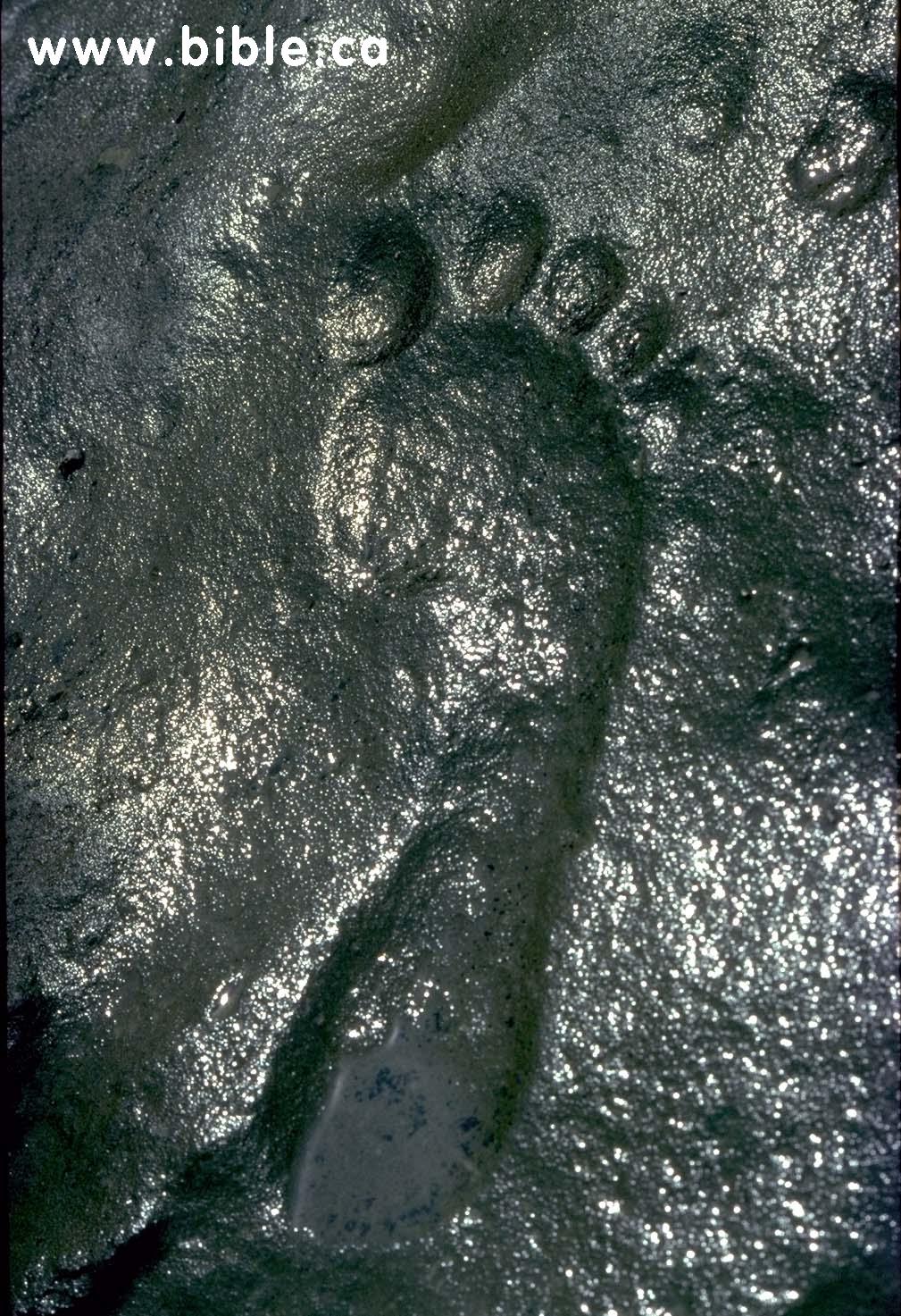
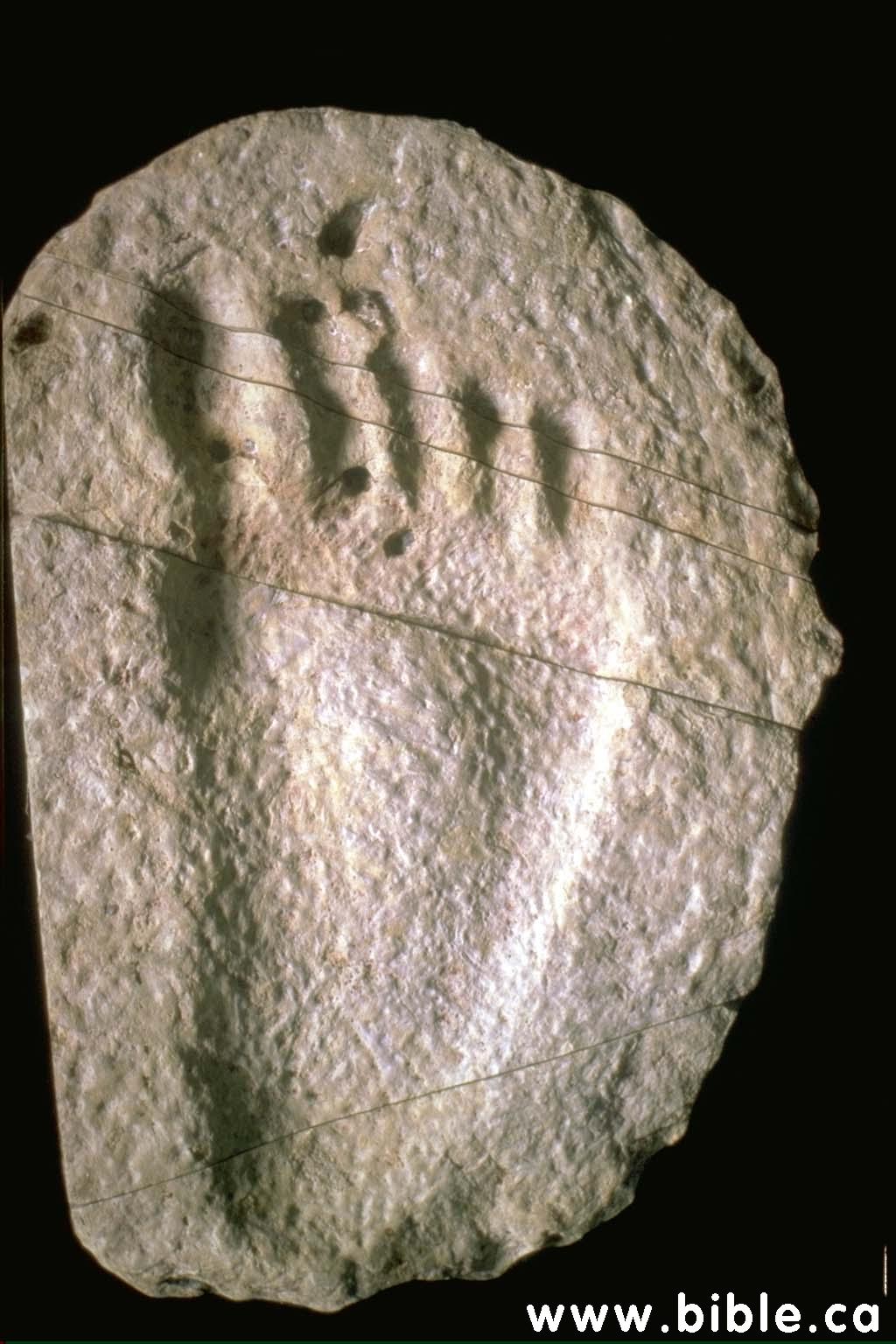
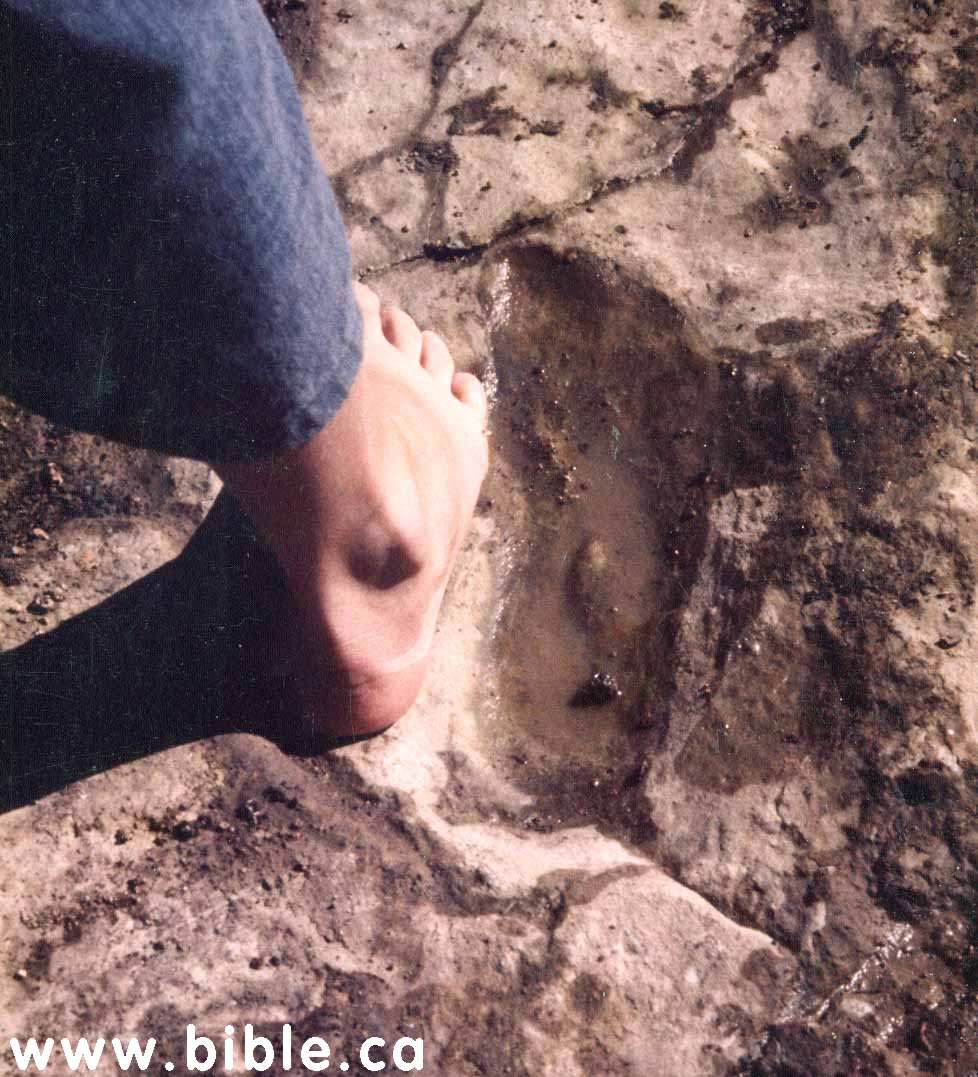
Hmmm, maybe the theory of Evolution is falsifiable after all...
Check out this link:
DINOSAUR AND HUMAN FOOTPRINTS WEBSITE
Especially notice this:
HUMAN FOOTPRINT
And this:
DINOSAUR FOOTPRINT
And this:
HUMAN FOOTPRINT 2
And this:
SIDE BY SIDE WITH MODERN FOOT
And this:
HUMAN FOOTPRINT 3
"NOVA TV Special, God, Darwin And The Dinosaurs, "...dinosaur footprints, side by side with humans. Finding them would counter evidence that humans evolved long after the dinosaurs became extinct and back up...[the] claim that all species, including man, were created at one time."
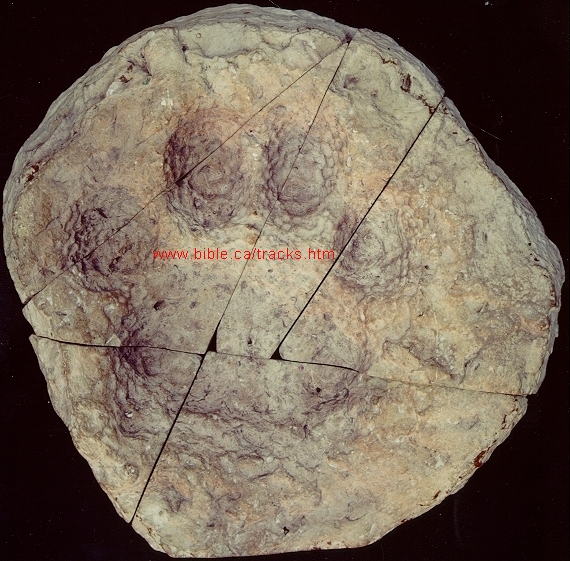
And this large cat track:
BIG CAT PAWPRINT
"Naturally, evolutionists must explain this away, so they just say, "It is carved." They don’t need evidence. They know large mammals did not live with dinosaurs, so this cat track must be carved.
Creationists on the other hand, test their hypotheses. We cross-sectioned the track with a view to looking for the possibility of subsurface structures. If the structures within the rock were randomly truncated by the foot-shaped depression, carving would be indicated. If however, the structures conformed to the depression, then there would be clear indication that the track was not carved, but genuine."
LARGE CAT TRACK FOUND AT GLEN ROSE
Some people might say, "If these are real, then why haven't we seen them in the News? If they were real, they would be all over the media!" However, evolutionary Scientists have a vested interest in their occupation. Besides that, they are prejudiced on the side of Evolution, and against the idea of Creation. Not only that, but the media filters out many things that go against its political or philosophical viewpoint. Scientists and reporters and the media are supposed to be disinterested parties that report on what they see, without letting their personal opinions affect what they report; but much of the time, this is not the case.
DINOSAUR AND HUMAN FOOTPRINTS WEBSITE
Especially notice this:
HUMAN FOOTPRINT
And this:
DINOSAUR FOOTPRINT
And this:
HUMAN FOOTPRINT 2
And this:
SIDE BY SIDE WITH MODERN FOOT
And this:
HUMAN FOOTPRINT 3
"NOVA TV Special, God, Darwin And The Dinosaurs, "...dinosaur footprints, side by side with humans. Finding them would counter evidence that humans evolved long after the dinosaurs became extinct and back up...[the] claim that all species, including man, were created at one time."
And this large cat track:
BIG CAT PAWPRINT
"Naturally, evolutionists must explain this away, so they just say, "It is carved." They don’t need evidence. They know large mammals did not live with dinosaurs, so this cat track must be carved.
Creationists on the other hand, test their hypotheses. We cross-sectioned the track with a view to looking for the possibility of subsurface structures. If the structures within the rock were randomly truncated by the foot-shaped depression, carving would be indicated. If however, the structures conformed to the depression, then there would be clear indication that the track was not carved, but genuine."
LARGE CAT TRACK FOUND AT GLEN ROSE
Some people might say, "If these are real, then why haven't we seen them in the News? If they were real, they would be all over the media!" However, evolutionary Scientists have a vested interest in their occupation. Besides that, they are prejudiced on the side of Evolution, and against the idea of Creation. Not only that, but the media filters out many things that go against its political or philosophical viewpoint. Scientists and reporters and the media are supposed to be disinterested parties that report on what they see, without letting their personal opinions affect what they report; but much of the time, this is not the case.
Thursday, April 10, 2008
Are All "Real" Scientists Atheists?
"The idea that all scientists and educated people are atheists is a myth. The Sigma Zi [Xi] Scientific Honorary Society did a poll of 3,300 PhD’s and concluded that scientists are anchored in the US mainstream and that 1/2 participate in religious activities regularly."
"Richard Feynman (Nobel prize in physics) has said, "Many scientists do believe in both science and God, a God of revelation, in a perfectly consistent way."
http://www.reallifeboston.com/resources/12questions/3.php
"Richard Feynman (Nobel prize in physics) has said, "Many scientists do believe in both science and God, a God of revelation, in a perfectly consistent way."
http://www.reallifeboston.com/resources/12questions/3.php
Tuesday, April 8, 2008
Taking the side of Science
"We take the side of science in spite of the patent absurdity of some of its constructs, in spite of the failure to fulfill many of its extravagant promises of health and life, in spite of the tolerance of the scientific community for unsubstantiated just-so-stories, because we have a prior commitment, a commitment to materialism. It is not that the methods and institutions of science somehow compel us to accept a material explanation of the phenomenal world, but, on the contrary, that we are forced by our a priori adherence to material causes to create an apparatus of investigation and a set of concepts that produce material explanations, no matter how mystifying to the uninitiated. Moreover, that materialism is an absolute, for we cannot allow a Divine Foot in the door."
(Evolutionist Richard Lewontin in The New York Review, January, 1997, page 31)
(Evolutionist Richard Lewontin in The New York Review, January, 1997, page 31)
Monday, April 7, 2008
Survival of the sacred
"Why religion is winning
By Dinesh D'Souza
November 11, 2007
The vigorous, the healthy and the happy survive and multiply.
– Charles Darwin, The Origin of Species
Religion continues to grow worldwide, and atheists in America and the West are having a difficult time explaining why. These nonbelievers, most of them Darwinists, are convinced there must be some biological explanation for why, in every culture since the beginning of history, man has found and continues to find solace in religion. Biologist Richard Dawkins confesses that religion poses a “major puzzle to anyone who thinks in a Darwinian way.”
Here, from the evolutionary point of view, is the problem. Scholars such as anthropologist Scott Atran presume that religious beliefs are nothing more than illusions. Atran contends that religious belief requires taking “what is materially false to be true” and “what is materially true to be false.” For Atran and others, religion requires a commitment to “factually impossible worlds.” The question, then, is why would humans evolve in such a way that they come to believe in things that don't exist?
Philosopher Daniel Dennett states the problem clearly: “The ultimate measure of evolutionary value is fitness – the capacity to replicate more successfully than the competition does.” Yet on the face of it religion seems useless from an evolutionary point of view. It costs time and money, and it induces its members to make sacrifices that undermine their well-being for the benefit of others, sometimes total strangers.
Religious people build cathedrals and pyramids that have very little utility except as houses of worship and burial. The ancient Hebrews sacrificed their fattest calves to Yahweh, and even today people slaughter goats and chickens on altars. Religious people sometimes forgo certain foods; the cow is holy to the Hindus, and the pig unholy to the Muslims. Christians give tithes and financial offerings in church. The Jews keep holy the Sabbath, as Christians keep Sunday for church. Religious people recite prayers and go on pilgrimages. Some become missionaries or devote their lives to serving others. Some are even willing to die for their religious beliefs.
A critical question
The evolutionary biologist wonders: Why would evolved creatures like human beings bent on survival and reproduction do things that seem unrelated, even inimical, to those objectives? This is a critical question, not only because religion poses an intellectual dilemma for Darwinists, but also because Darwinists are hoping that by explaining the existence of religion they can expose its natural roots and undermine its supernatural authority. Biologist E.O. Wilson writes that “we have come to the crucial stage in the history of biology when religion itself is subject to the explanations of the natural sciences.” He expresses the hope that sometime soon “the final decisive edge enjoyed by scientific naturalism will come from its capacity to explain traditional religion, its chief competitor, as a wholly material phenomenon.”
So how far have these evolutionary theories progressed in accounting for the success of religion? In “The God Delusion” Dawkins writes, “The proximate cause of religion might be hyperactivity in a particular node of the brain.” He also speculates that “the idea of immortality survives and spreads because it caters to wishful thinking.” But it makes no evolutionary sense for minds to develop comforting beliefs that are evidently false. Explains cognitive psychologist Steven Pinker: “A freezing person finds no comfort in believing he is warm. A person face to face with a lion is not put at ease by the conviction that he is a rabbit.” Wishful thinking of this sort would quickly have become extinct as its practitioners froze or were eaten.
Yet Pinker's own solution to the problem is no better than that of Dawkins. He suggests there might be a “God module” in the brain that predisposes people to believe in the Almighty. Such a module, Pinker writes, might serve no survival purpose but could have evolved as a byproduct of other modules with evolutionary value. This is another way of saying there is no Darwinian explanation. After all, if a “God module” produces belief in God, how about a “Darwin module” that produces belief in evolution?
Still, the question raised by the Darwinists is not a foolish one. Biologists such as Dawkins and Wilson say there simply must be some natural and evolutionary explanation for the universality and persistence of religious belief, and they are right. There is such an explanation, and as a religious believer I am happy to provide one.
Two creation stories
The Rev. Randy Alcorn, founder of Eternal Perspective Ministries in Oregon, sometimes presents his audiences with two creation stories and asks them whether it matters which one is true. In the secular account, “You are the descendant of a tiny cell of primordial protoplasm washed up on an empty beach three-and-a-half-billion years ago. You are the blind and arbitrary product of time, chance and natural forces. You are a mere grab-bag of atomic particles, a conglomeration of genetic substance. You exist on a tiny planet in a minute solar system in an empty corner of a meaningless universe. You are a purely biological entity, different only in degree but not in kind from a microbe, virus or amoeba. You have no essence beyond your body, and at death you will cease to exist entirely. In short, you came from nothing and are going nowhere.”
In the Christian view, by contrast, “You are the special creation of a good and all-powerful God. You are created in his image, with capacities to think, feel and worship that set you above all other life forms. You differ from the animals not simply in degree but in kind. Not only is your kind unique, but you are unique among your kind. Your creator loves you so much and so intensely desires your companionship and affection that he has a perfect plan for your life. In addition, God gave the life of his only Son that you might spend eternity with him. If you are willing to accept the gift of salvation, you can become a child of God.”
Now imagine two groups of people – let's call them the Secular Tribe and the Religious Tribe – who subscribe to these two world views. Which of the two tribes is more likely to survive, prosper and multiply? The Religious Tribe is made up of people who have an animating sense of purpose. The Secular Tribe is made up of people who are not sure why they exist at all. The Religious Tribe is composed of individuals who view their every thought and action as consequential. The Secular Tribe is made up of matter that cannot explain why it is able to think at all.
Should evolutionists such as Dennett, Dawkins, Pinker and Wilson be surprised, then, to see that religious tribes are flourishing? Throughout the world, religious groups attract astounding numbers of followers and religious people are showing their confidence in their way of life and in the future by having more children. Despite the sales figures of atheist best-sellers, atheism remains a minority lifestyle and the largest atheist organizations have only a few thousand members.
The important point is not just that atheism is unable to compete with religion in attracting followers, but also that the lifestyle of practical atheism seems to produce listless tribes that cannot even reproduce themselves. Sociologists Pippa Norris and Ron Inglehart note that many richer, more secular countries are “producing only about half as many children as would be needed to replace the adult population” while many poorer, more religious countries are “producing two or three times as many children as would be needed to replace the adult population.” The consequence, so predictable that one might almost call it a law, is that “the religious population is growing fast, while the secular number is shrinking.”
Country by country
Russia is one of the most atheist countries in the world and abortions there out-number live births by a 2-to-1 ratio. Russia's birthrate has fallen so low that the nation is now losing 700,000 people a year. Japan, perhaps the most secular country in Asia, is also on a kind of population diet: its 130 million people are expected to drop to around 100 million in the next few decades. Canada, Australia and New Zealand find themselves in a similar predicament.
Then there is Europe. The most secular continent on the globe is decadent in the quite literal sense that its population is rapidly shrinking. Birthrates are abysmally low in France, Italy, Spain, the Czech Republic and Sweden. The nations of Western Europe today show some of the lowest birthrates ever recorded, and Eastern European birthrates are comparably low. Historians have noted that Europe is suffering the most sustained reduction in its population since the Black Death in the 14th century, when one in three Europeans succumbed to the plague. Lacking the strong religious identity that once characterized Christendom, atheist Europe seems to be a civilization on its way out. The philosopher Nietzsche predicted that European decadence would produce a miserable “last man” devoid of any purpose beyond making life comfortable and making provision for regular fornication. Well, Nietzsche's “last man” is finally here, and his name is Sven.
Eric Kaufmann has noted that in America, where high levels of immigration have helped to compensate for falling native birthrates, birthrates among religious people are nearly twice as high as those for secular people. This trend has also been noticed in Europe. What this means is that, by a kind of natural selection, the West is likely to evolve in a more religious direction.
This tendency will likely accelerate if Western societies continue to import immigrants from more religious societies, whether they are Christian or Muslim. Thus we can expect even the most secular regions of the world, through the sheer logic of demography, to become less secular over time.
In previous decades, scholars have tried to give a purely economic explanation for demographic trends. The general idea was that population was a function of affluence. Sociologists noted that as people and countries became richer, they had fewer children. Presumably, primitive societies needed children to help in the fields, and more prosperous societies no longer did. Poor people were also believed to have more children because sex provided one of their only means of recreation. Moreover, poor people are often ignorant about birth control or don't have access to it. From this perspective, large families were explained as a phenomenon of poverty and ignorance.
The economic explanation is partly true, but it falls short of the full picture. Poor people reproduce at higher rates despite having access to birth control and movie tickets; it turns out they generally want larger families. Sure, they are more economically dependent on their children, but on the other hand rich people can afford more children. Wealthy people in America today tend to have one child or none, but wealthy families in the past tended to have three or more children. The real difference is not merely in the level of income, it is that in the past children were valued as gifts from God, and traditional cultures still view them that way.
Muslim countries, with their oil revenues, are by no means the poorest in the world and yet they have among the highest birth rates. Practicing Catholics, orthodox Jews, Mormons and evangelical Protestants are by no means the poorest groups in America, and yet they have large families. Clearly, religious factors are at work here. The declining birthrates in the West as a whole are, in considerable part, due to secularization. The religious motive for childbearing has been greatly attenuated, and children are now viewed by many people as instruments of self-gratification. The old biblical principle was “Be fruitful and multiply.” The new one is “Have as many children as will enhance your lifestyle.”
False prophets
The economic forecasters of the disappearance of religion have proven themselves to be false prophets. Not only is religion thriving, it is thriving because it helps people adapt and survive in the world. In his book “Darwin's Cathedral,” evolutionary biologist David Sloan Wilson argues that religion provides something that secular society doesn't: a vision of transcendent purpose. Consequently, religious people develop a zest for life that is, in a sense, unnatural. They exhibit a hopefulness about the future that may exceed what is warranted by how the world is going. And they forge principles of morality and charity that simply make their group more cohesive, adaptive and successful than groups whose members lack this binding and elevating force.
My conclusion is that it is not religion but atheism that requires a Darwinian explanation. It seems perplexing why nature would breed a group of people who see no higher purpose to life or the universe. Here is where the biological expertise of Dawkins, Pinker and Wilson could prove illuminating. Maybe they can turn their Darwinian lens on themselves and help us understand how atheism, like the human tailbone and the panda's thumb, somehow survived as an evolutionary leftover of our primitive past.
D'Souza's new book, “What's So Great About Christianity,” is published by Regnery. Website: dineshdsouza.com. Email: dineshjdsouza@aol.com."
http://www.signonsandiego.com/uniontrib/20071111/news_mz1e11dsouza.html
By Dinesh D'Souza
November 11, 2007
The vigorous, the healthy and the happy survive and multiply.
– Charles Darwin, The Origin of Species
Religion continues to grow worldwide, and atheists in America and the West are having a difficult time explaining why. These nonbelievers, most of them Darwinists, are convinced there must be some biological explanation for why, in every culture since the beginning of history, man has found and continues to find solace in religion. Biologist Richard Dawkins confesses that religion poses a “major puzzle to anyone who thinks in a Darwinian way.”
Here, from the evolutionary point of view, is the problem. Scholars such as anthropologist Scott Atran presume that religious beliefs are nothing more than illusions. Atran contends that religious belief requires taking “what is materially false to be true” and “what is materially true to be false.” For Atran and others, religion requires a commitment to “factually impossible worlds.” The question, then, is why would humans evolve in such a way that they come to believe in things that don't exist?
Philosopher Daniel Dennett states the problem clearly: “The ultimate measure of evolutionary value is fitness – the capacity to replicate more successfully than the competition does.” Yet on the face of it religion seems useless from an evolutionary point of view. It costs time and money, and it induces its members to make sacrifices that undermine their well-being for the benefit of others, sometimes total strangers.
Religious people build cathedrals and pyramids that have very little utility except as houses of worship and burial. The ancient Hebrews sacrificed their fattest calves to Yahweh, and even today people slaughter goats and chickens on altars. Religious people sometimes forgo certain foods; the cow is holy to the Hindus, and the pig unholy to the Muslims. Christians give tithes and financial offerings in church. The Jews keep holy the Sabbath, as Christians keep Sunday for church. Religious people recite prayers and go on pilgrimages. Some become missionaries or devote their lives to serving others. Some are even willing to die for their religious beliefs.
A critical question
The evolutionary biologist wonders: Why would evolved creatures like human beings bent on survival and reproduction do things that seem unrelated, even inimical, to those objectives? This is a critical question, not only because religion poses an intellectual dilemma for Darwinists, but also because Darwinists are hoping that by explaining the existence of religion they can expose its natural roots and undermine its supernatural authority. Biologist E.O. Wilson writes that “we have come to the crucial stage in the history of biology when religion itself is subject to the explanations of the natural sciences.” He expresses the hope that sometime soon “the final decisive edge enjoyed by scientific naturalism will come from its capacity to explain traditional religion, its chief competitor, as a wholly material phenomenon.”
So how far have these evolutionary theories progressed in accounting for the success of religion? In “The God Delusion” Dawkins writes, “The proximate cause of religion might be hyperactivity in a particular node of the brain.” He also speculates that “the idea of immortality survives and spreads because it caters to wishful thinking.” But it makes no evolutionary sense for minds to develop comforting beliefs that are evidently false. Explains cognitive psychologist Steven Pinker: “A freezing person finds no comfort in believing he is warm. A person face to face with a lion is not put at ease by the conviction that he is a rabbit.” Wishful thinking of this sort would quickly have become extinct as its practitioners froze or were eaten.
Yet Pinker's own solution to the problem is no better than that of Dawkins. He suggests there might be a “God module” in the brain that predisposes people to believe in the Almighty. Such a module, Pinker writes, might serve no survival purpose but could have evolved as a byproduct of other modules with evolutionary value. This is another way of saying there is no Darwinian explanation. After all, if a “God module” produces belief in God, how about a “Darwin module” that produces belief in evolution?
Still, the question raised by the Darwinists is not a foolish one. Biologists such as Dawkins and Wilson say there simply must be some natural and evolutionary explanation for the universality and persistence of religious belief, and they are right. There is such an explanation, and as a religious believer I am happy to provide one.
Two creation stories
The Rev. Randy Alcorn, founder of Eternal Perspective Ministries in Oregon, sometimes presents his audiences with two creation stories and asks them whether it matters which one is true. In the secular account, “You are the descendant of a tiny cell of primordial protoplasm washed up on an empty beach three-and-a-half-billion years ago. You are the blind and arbitrary product of time, chance and natural forces. You are a mere grab-bag of atomic particles, a conglomeration of genetic substance. You exist on a tiny planet in a minute solar system in an empty corner of a meaningless universe. You are a purely biological entity, different only in degree but not in kind from a microbe, virus or amoeba. You have no essence beyond your body, and at death you will cease to exist entirely. In short, you came from nothing and are going nowhere.”
In the Christian view, by contrast, “You are the special creation of a good and all-powerful God. You are created in his image, with capacities to think, feel and worship that set you above all other life forms. You differ from the animals not simply in degree but in kind. Not only is your kind unique, but you are unique among your kind. Your creator loves you so much and so intensely desires your companionship and affection that he has a perfect plan for your life. In addition, God gave the life of his only Son that you might spend eternity with him. If you are willing to accept the gift of salvation, you can become a child of God.”
Now imagine two groups of people – let's call them the Secular Tribe and the Religious Tribe – who subscribe to these two world views. Which of the two tribes is more likely to survive, prosper and multiply? The Religious Tribe is made up of people who have an animating sense of purpose. The Secular Tribe is made up of people who are not sure why they exist at all. The Religious Tribe is composed of individuals who view their every thought and action as consequential. The Secular Tribe is made up of matter that cannot explain why it is able to think at all.
Should evolutionists such as Dennett, Dawkins, Pinker and Wilson be surprised, then, to see that religious tribes are flourishing? Throughout the world, religious groups attract astounding numbers of followers and religious people are showing their confidence in their way of life and in the future by having more children. Despite the sales figures of atheist best-sellers, atheism remains a minority lifestyle and the largest atheist organizations have only a few thousand members.
The important point is not just that atheism is unable to compete with religion in attracting followers, but also that the lifestyle of practical atheism seems to produce listless tribes that cannot even reproduce themselves. Sociologists Pippa Norris and Ron Inglehart note that many richer, more secular countries are “producing only about half as many children as would be needed to replace the adult population” while many poorer, more religious countries are “producing two or three times as many children as would be needed to replace the adult population.” The consequence, so predictable that one might almost call it a law, is that “the religious population is growing fast, while the secular number is shrinking.”
Country by country
Russia is one of the most atheist countries in the world and abortions there out-number live births by a 2-to-1 ratio. Russia's birthrate has fallen so low that the nation is now losing 700,000 people a year. Japan, perhaps the most secular country in Asia, is also on a kind of population diet: its 130 million people are expected to drop to around 100 million in the next few decades. Canada, Australia and New Zealand find themselves in a similar predicament.
Then there is Europe. The most secular continent on the globe is decadent in the quite literal sense that its population is rapidly shrinking. Birthrates are abysmally low in France, Italy, Spain, the Czech Republic and Sweden. The nations of Western Europe today show some of the lowest birthrates ever recorded, and Eastern European birthrates are comparably low. Historians have noted that Europe is suffering the most sustained reduction in its population since the Black Death in the 14th century, when one in three Europeans succumbed to the plague. Lacking the strong religious identity that once characterized Christendom, atheist Europe seems to be a civilization on its way out. The philosopher Nietzsche predicted that European decadence would produce a miserable “last man” devoid of any purpose beyond making life comfortable and making provision for regular fornication. Well, Nietzsche's “last man” is finally here, and his name is Sven.
Eric Kaufmann has noted that in America, where high levels of immigration have helped to compensate for falling native birthrates, birthrates among religious people are nearly twice as high as those for secular people. This trend has also been noticed in Europe. What this means is that, by a kind of natural selection, the West is likely to evolve in a more religious direction.
This tendency will likely accelerate if Western societies continue to import immigrants from more religious societies, whether they are Christian or Muslim. Thus we can expect even the most secular regions of the world, through the sheer logic of demography, to become less secular over time.
In previous decades, scholars have tried to give a purely economic explanation for demographic trends. The general idea was that population was a function of affluence. Sociologists noted that as people and countries became richer, they had fewer children. Presumably, primitive societies needed children to help in the fields, and more prosperous societies no longer did. Poor people were also believed to have more children because sex provided one of their only means of recreation. Moreover, poor people are often ignorant about birth control or don't have access to it. From this perspective, large families were explained as a phenomenon of poverty and ignorance.
The economic explanation is partly true, but it falls short of the full picture. Poor people reproduce at higher rates despite having access to birth control and movie tickets; it turns out they generally want larger families. Sure, they are more economically dependent on their children, but on the other hand rich people can afford more children. Wealthy people in America today tend to have one child or none, but wealthy families in the past tended to have three or more children. The real difference is not merely in the level of income, it is that in the past children were valued as gifts from God, and traditional cultures still view them that way.
Muslim countries, with their oil revenues, are by no means the poorest in the world and yet they have among the highest birth rates. Practicing Catholics, orthodox Jews, Mormons and evangelical Protestants are by no means the poorest groups in America, and yet they have large families. Clearly, religious factors are at work here. The declining birthrates in the West as a whole are, in considerable part, due to secularization. The religious motive for childbearing has been greatly attenuated, and children are now viewed by many people as instruments of self-gratification. The old biblical principle was “Be fruitful and multiply.” The new one is “Have as many children as will enhance your lifestyle.”
False prophets
The economic forecasters of the disappearance of religion have proven themselves to be false prophets. Not only is religion thriving, it is thriving because it helps people adapt and survive in the world. In his book “Darwin's Cathedral,” evolutionary biologist David Sloan Wilson argues that religion provides something that secular society doesn't: a vision of transcendent purpose. Consequently, religious people develop a zest for life that is, in a sense, unnatural. They exhibit a hopefulness about the future that may exceed what is warranted by how the world is going. And they forge principles of morality and charity that simply make their group more cohesive, adaptive and successful than groups whose members lack this binding and elevating force.
My conclusion is that it is not religion but atheism that requires a Darwinian explanation. It seems perplexing why nature would breed a group of people who see no higher purpose to life or the universe. Here is where the biological expertise of Dawkins, Pinker and Wilson could prove illuminating. Maybe they can turn their Darwinian lens on themselves and help us understand how atheism, like the human tailbone and the panda's thumb, somehow survived as an evolutionary leftover of our primitive past.
D'Souza's new book, “What's So Great About Christianity,” is published by Regnery. Website: dineshdsouza.com. Email: dineshjdsouza@aol.com."
http://www.signonsandiego.com/uniontrib/20071111/news_mz1e11dsouza.html
Tuesday, March 11, 2008
The missing link
"The missing link between man and the apes...is merely the most glamorous of a whole hierarchy of phantom creatures. In the fossil record, missing links are the rule: the story of life is as disjointed as a silent newsreel, in which species succeed one another as abruptly as Balkan prime ministers. The more scientists have searched for the transitional forms between species, the more they have been frustrated... Evidence from fossils now points overwhelmingly away from the classical Darwinism which most Americans learned in high school..." [Newsweek, Is Man a Subtle Accident? Nov. 3, 1980 p. 95.]
Saturday, March 8, 2008
Archaeoraptor Liaoningensis: Fake Dinosaur-bird ancestor
Today I want to point out another evolution fraud, this time committed in China and published in 1999 in the journal "National Geographic" 196:98-107, November, 1999. Dinosaur bones were put together with the bones of a newer species of bird, and they tried to pass it off as a very important new evolutionary intermediate.
"Feathers For T-Rex?", Christopher P. Sloan, National Geographic Magazine, Vol. 196, No. 5, November, 1999, pp.99,100,105
"National Geographic has reached an all-time low for engaging in sensationalistic, unsubstantiated, tabloid journalism."
(Storrs L. Olson, Smithsonian Institution)
"Feathers For T-Rex?", Christopher P. Sloan, National Geographic Magazine, Vol. 196, No. 5, November, 1999, pp.99,100,105
"National Geographic has reached an all-time low for engaging in sensationalistic, unsubstantiated, tabloid journalism."
(Storrs L. Olson, Smithsonian Institution)
Sunday, March 2, 2008
Asking the Forbidden Questions
According to Darwin, the absence of intermediate fossil forms “is the most obvious and gravest objection which can be urged against my theory.” What new fossil finds, if any, have occurred since Darwin wrote these words nearly 150 years ago? Do they overturn Darwin’s bleak assessment of evolutionary theory? If the absence of intermediate fossil forms holds as much today as it did back then, why should anyone accept evolution?
Progressions invariably come from organisms with the same basic body plan. In the “evolution” of the horse, we are always dealing with horse-like organisms. And even with the “evolution” of reptiles into mammals, we are dealing with land-dwelling vertebrates sharing many common structures. What we don’t see in the fossil record is animals with fundamentally different body plans evolving from a common ancestor. For instance, there is no fossil evidence whatsoever that insects and vertebrates share a common evolutionary ancestor.
The challenge that here confronts evolution is not isolated but pervasive, and comes up most flagrantly in what’s called the Cambrian Explosion. In a very brief window of time during the geological period known as the Cambrian, virtually all the basic animal types appeared suddenly in the fossil record with no trace of evolutionary ancestors. The Cambrian Explosion so flies in the face of evolution that paleontologist Peter Ward wrote, “If ever there was evidence suggesting Divine Creation, surely the Precambrian and Cambrian transition, known from numerous localities across the face of the earth, is it.” Note that Ward is not a creationist.
The challenge of the fossil record that Darwin identified 150 years ago has not gone away. To his credit, the late evolutionist Stephen Jay Gould conceded this point: “The extreme rarity of transitional forms in the fossil record persists as the trade secret of paleontology. The evolutionary trees that adorn our textbooks have data only at the tips and nodes of their branches; the rest is inference, however reasonable, not the evidence of fossils.
But IS this inference actually reasonable?
According to evolutionist Richard Dawkins, the “evidence of evolution reveals a universe without design.” Yet he also states, “Biology is the study of complicated things that give the appearance of having been designed for a purpose.” How does Dawkins know that living things only appear to be designed but are not actually designed?
The great fallacy of evolution is that it claims all the benefits of design without the need for actual design. In particular, evolution attributes intelligence, the power of choice, to a fundamentally irrational process, namely, natural selection. But nature has no power to choose. Real choices involve deliberation, that is, some consideration of future possibilities and consequences.
But natural selection is incapable of looking to the future. Instead, it acts on the spur of the moment, based solely on what the environment right now deems fit. It cannot plan for the future. It is incapable of deferring success or gratification. And yet, so limited a process is supposed to produce marvels of biological complexity and diversity that far exceed the capacities of the best human designers.
There’s no evidence that natural selection is up to the task. Natural selection is fine for explaining certain small-scale changes in organisms, like the beaks of birds adapting to environmental changes. It can take existing structures and hone them. But it can’t explain how you get complex structures in the first place. That’s why cell biologist Franklin Harold writes, “there are presently no detailed Darwinian accounts of the evolution of any biochemical or cellular system, only a variety of wishful speculations.
The search for extraterrestrial intelligence (SETI) is a scientific research program that looks for signs of intelligence from distant space. Should biologists likewise be looking for signs of intelligence in biological systems? Why or why not? Could actual intelligent design in biological systems be scientifically detectable?
After all, “intelligent design is scientifically detectable in many areas of science, such as archeology, forensics, and cryptography.” And “nonhuman intelligence could be scientifically detectable, as with SETI.”
Do any structures in the cell resemble highly intricate machines designed by humans?
Evolutionists claim that these structures evolved. But if so, how? Could such machines have features that place them beyond the reach of evolution?
There are structures in the cell that don’t just resemble humanly built machines—they actually are machines in every sense of the word.
Take, for instance, the bacterial flagellum, which is now referred to as the “Icon of Intelligent Design” by some evolutionists because it has been so effectively used to criticize evolution. The bacterial flagellum is a marvel of nano-engineering.
Biologist Howard Berg at Harvard refers to it as “the most efficient machine in the universe.” The flagellum is a little bi-directional motor-driven propeller that sits on the backs of certain bacteria and drives them through their watery environment. It spins at 20,000 rpm and can change direction in a quarter turn. It requires approximately 40 protein parts for its construction. If any of the parts are missing or not available in the right proportions, no functional flagellum will form. So, how did it evolve?
Despite thousands of research articles that have been written about the structure and function of the flagellum, biologists don’t have a clue how it could have evolved. Evolutionists have only one straw at which they continually grasp when trying to explain how the flagellum might have evolved, namely, that the flagellum contains within it a structure similar to a microsyringe found in some bacteria. Having found this sub-structure, evolutionists merrily conclude that the microsyringe must have evolved into the flagellum.
Such pathetic lapses in logic are everywhere in the evolutionary literature. The challenge for evolutionary theory is not to find components of such systems that could be grist of natural selection’s mill. Rather, it is to provide detailed, testable, step-by-step scenarios whereby such components could reasonably have come together to bring about the marvels of nano-engineering that we find in systems like the flagellum.
What evidence would convince you that evolution is false? If no such evidence exists, or indeed could exist, how can evolution be a testable scientific theory?
"The burden is on Darwin and his defenders to demonstrate that at least some complex organs we find in nature really can possibly be formed in this way, that is, by some specific, fully articulated series of slight modifications.” (University of Texas philosopher Robert Koons)
The evolutionist J. B. S. Haldane, when asked what would convince him that evolution was false, replied that finding a rabbit fossil in pre-Cambrian rocks would do quite nicely. Such a fossil would, by standard geological dating, be out of sequence by several hundreds of millions of years. Certainly such a finding, if rigorously confirmed, would overturn the current understanding of the history of life. But it would not overturn evolution.
Haldane’s rabbit is easily enough explained as an evolutionary convergence, in which essentially the same structure or life form evolves twice. In place of a common underlying intelligent design, evolutionists invoke evolutionary convergence whenever confronted with similar biological structures that cannot reasonably be traced back to a common evolutionary ancestor.
So long as some unknown or unexplored evolutionary pathway might have led to the formation of some biological structure or organism, evolutionists prefer it over alternative explanations such as intelligent design. And since the unknown and unexplored allow for an infinity of loopholes, the committed evolutionist regards Darwinian and other materialist explanations of life’s origin and subsequent development as always trumping alternative explanations, regardless of the evidence.
Richard Halvorson, writing for the “Harvard Crimson,” has aptly remarked, “We must refuse to bow to our culture’s false idols. Science will not benefit from canonizing Darwin or making evolution an article of secular faith. We must reject intellectual excommunication as a valid form of dealing with criticism: the most important question for any society to ask is the one that is forbidden.
Evolution has become an ideology, and the one thing that ideologies fear is exposure.
That’s why evolution forbids certain lines of questioning. But the questions need to be asked. Too much is riding on evolution for it to escape proper scrutiny.
http://www.designinference.com/documents/2004.04.Five_Questions_Ev.pdf
Progressions invariably come from organisms with the same basic body plan. In the “evolution” of the horse, we are always dealing with horse-like organisms. And even with the “evolution” of reptiles into mammals, we are dealing with land-dwelling vertebrates sharing many common structures. What we don’t see in the fossil record is animals with fundamentally different body plans evolving from a common ancestor. For instance, there is no fossil evidence whatsoever that insects and vertebrates share a common evolutionary ancestor.
The challenge that here confronts evolution is not isolated but pervasive, and comes up most flagrantly in what’s called the Cambrian Explosion. In a very brief window of time during the geological period known as the Cambrian, virtually all the basic animal types appeared suddenly in the fossil record with no trace of evolutionary ancestors. The Cambrian Explosion so flies in the face of evolution that paleontologist Peter Ward wrote, “If ever there was evidence suggesting Divine Creation, surely the Precambrian and Cambrian transition, known from numerous localities across the face of the earth, is it.” Note that Ward is not a creationist.
The challenge of the fossil record that Darwin identified 150 years ago has not gone away. To his credit, the late evolutionist Stephen Jay Gould conceded this point: “The extreme rarity of transitional forms in the fossil record persists as the trade secret of paleontology. The evolutionary trees that adorn our textbooks have data only at the tips and nodes of their branches; the rest is inference, however reasonable, not the evidence of fossils.
But IS this inference actually reasonable?
According to evolutionist Richard Dawkins, the “evidence of evolution reveals a universe without design.” Yet he also states, “Biology is the study of complicated things that give the appearance of having been designed for a purpose.” How does Dawkins know that living things only appear to be designed but are not actually designed?
The great fallacy of evolution is that it claims all the benefits of design without the need for actual design. In particular, evolution attributes intelligence, the power of choice, to a fundamentally irrational process, namely, natural selection. But nature has no power to choose. Real choices involve deliberation, that is, some consideration of future possibilities and consequences.
But natural selection is incapable of looking to the future. Instead, it acts on the spur of the moment, based solely on what the environment right now deems fit. It cannot plan for the future. It is incapable of deferring success or gratification. And yet, so limited a process is supposed to produce marvels of biological complexity and diversity that far exceed the capacities of the best human designers.
There’s no evidence that natural selection is up to the task. Natural selection is fine for explaining certain small-scale changes in organisms, like the beaks of birds adapting to environmental changes. It can take existing structures and hone them. But it can’t explain how you get complex structures in the first place. That’s why cell biologist Franklin Harold writes, “there are presently no detailed Darwinian accounts of the evolution of any biochemical or cellular system, only a variety of wishful speculations.
The search for extraterrestrial intelligence (SETI) is a scientific research program that looks for signs of intelligence from distant space. Should biologists likewise be looking for signs of intelligence in biological systems? Why or why not? Could actual intelligent design in biological systems be scientifically detectable?
After all, “intelligent design is scientifically detectable in many areas of science, such as archeology, forensics, and cryptography.” And “nonhuman intelligence could be scientifically detectable, as with SETI.”
Do any structures in the cell resemble highly intricate machines designed by humans?
Evolutionists claim that these structures evolved. But if so, how? Could such machines have features that place them beyond the reach of evolution?
There are structures in the cell that don’t just resemble humanly built machines—they actually are machines in every sense of the word.
Take, for instance, the bacterial flagellum, which is now referred to as the “Icon of Intelligent Design” by some evolutionists because it has been so effectively used to criticize evolution. The bacterial flagellum is a marvel of nano-engineering.
Biologist Howard Berg at Harvard refers to it as “the most efficient machine in the universe.” The flagellum is a little bi-directional motor-driven propeller that sits on the backs of certain bacteria and drives them through their watery environment. It spins at 20,000 rpm and can change direction in a quarter turn. It requires approximately 40 protein parts for its construction. If any of the parts are missing or not available in the right proportions, no functional flagellum will form. So, how did it evolve?
Despite thousands of research articles that have been written about the structure and function of the flagellum, biologists don’t have a clue how it could have evolved. Evolutionists have only one straw at which they continually grasp when trying to explain how the flagellum might have evolved, namely, that the flagellum contains within it a structure similar to a microsyringe found in some bacteria. Having found this sub-structure, evolutionists merrily conclude that the microsyringe must have evolved into the flagellum.
Such pathetic lapses in logic are everywhere in the evolutionary literature. The challenge for evolutionary theory is not to find components of such systems that could be grist of natural selection’s mill. Rather, it is to provide detailed, testable, step-by-step scenarios whereby such components could reasonably have come together to bring about the marvels of nano-engineering that we find in systems like the flagellum.
What evidence would convince you that evolution is false? If no such evidence exists, or indeed could exist, how can evolution be a testable scientific theory?
"The burden is on Darwin and his defenders to demonstrate that at least some complex organs we find in nature really can possibly be formed in this way, that is, by some specific, fully articulated series of slight modifications.” (University of Texas philosopher Robert Koons)
The evolutionist J. B. S. Haldane, when asked what would convince him that evolution was false, replied that finding a rabbit fossil in pre-Cambrian rocks would do quite nicely. Such a fossil would, by standard geological dating, be out of sequence by several hundreds of millions of years. Certainly such a finding, if rigorously confirmed, would overturn the current understanding of the history of life. But it would not overturn evolution.
Haldane’s rabbit is easily enough explained as an evolutionary convergence, in which essentially the same structure or life form evolves twice. In place of a common underlying intelligent design, evolutionists invoke evolutionary convergence whenever confronted with similar biological structures that cannot reasonably be traced back to a common evolutionary ancestor.
So long as some unknown or unexplored evolutionary pathway might have led to the formation of some biological structure or organism, evolutionists prefer it over alternative explanations such as intelligent design. And since the unknown and unexplored allow for an infinity of loopholes, the committed evolutionist regards Darwinian and other materialist explanations of life’s origin and subsequent development as always trumping alternative explanations, regardless of the evidence.
Richard Halvorson, writing for the “Harvard Crimson,” has aptly remarked, “We must refuse to bow to our culture’s false idols. Science will not benefit from canonizing Darwin or making evolution an article of secular faith. We must reject intellectual excommunication as a valid form of dealing with criticism: the most important question for any society to ask is the one that is forbidden.
Evolution has become an ideology, and the one thing that ideologies fear is exposure.
That’s why evolution forbids certain lines of questioning. But the questions need to be asked. Too much is riding on evolution for it to escape proper scrutiny.
http://www.designinference.com/documents/2004.04.Five_Questions_Ev.pdf
Monday, February 18, 2008
The wrath of God against unbelievers
"For the wrath of God is revealed from heaven against all ungodliness and unrighteousness of men, who hold the truth in unrighteousness;
Because that which may be known of God is manifest in them; for God hath shewed it unto them.
For the invisible things of him from the creation of the world are clearly seen, being understood by the things that are made, even his eternal power and Godhead; so that they are without excuse:
Because that, when they knew God, they glorified him not as God, neither were thankful; but became vain in their imaginations, and their foolish heart was darkened."
(Romans 1:18-21)
Because that which may be known of God is manifest in them; for God hath shewed it unto them.
For the invisible things of him from the creation of the world are clearly seen, being understood by the things that are made, even his eternal power and Godhead; so that they are without excuse:
Because that, when they knew God, they glorified him not as God, neither were thankful; but became vain in their imaginations, and their foolish heart was darkened."
(Romans 1:18-21)
Subscribe to:
Posts (Atom)


 Posts
Posts