I will get back to the lessons on Islam, but I wanted to share this excellent video.
Showing posts with label christian. Show all posts
Showing posts with label christian. Show all posts
Wednesday, October 7, 2009


Tuesday, July 22, 2008
The Christian Revival in the Muslim World
By Mike White,
published Aug 23, 2007
"Through the centuries Christians have shared their faith with Muslims-the same as they have with any group of people. Often it is been with little result. Although there may still be countless Muslims who are not interested in Christ, things are changing. Various sources report that although there may be many Muslims not interested in the gospel of Jesus Christ, there is a Christian revival, as Arabs, young and old alike, educated and those who are not educated are turning to Christ. Those who do often pay a heavy price for their new faith.
"I see many Arabic-speaking people turning to Christ, accepting Him as Lord and Savior," Nizar Shaheen, host of Light for the Nations, a Christian program seen throughout the Muslim world, said as reported on the website, www.cbn.com. "It's happening all over the Arab world. It's happening in North Africa. It's happening in the Middle East....in the Gulf countries....Canada and the United States."
Other experts say that that current Christian revival among Muslims is unprecedented, among all age groups, educational backgrounds, and among male and females.
One such convert is Achmad Muhammed, a Wahhabi sheik, who came from one of the most violent forms of Islam, a man who hated Christians and the Christian church. He now says that since he committed his life to Jesus Christ, He forgave his sins and gave him eternal life and peace.
A part of the evangelical spark among Muslims involves atheistic China. Chinese house churches, in the country which greatly persecute Christians, plan to send 100,000 through many Muslim nations and back to Israel.
The evangelization of the Muslim world has also involved the work of evangelists, satellite television, and the Internet.
Christine Darg, author of The Jesus Visions: Signs and Wonders in the Muslim World, said God is revealing throughout the Arab world how that God let His Son die on the cross and be raised again from the dead to provide the forgiveness of sins for the whole world-including Muslims.
Muslims who do become Christians, however, can face persecution, discrimination, or even martyrdom."
from:
http://tinyurl.com/5um8d4
published Aug 23, 2007
"Through the centuries Christians have shared their faith with Muslims-the same as they have with any group of people. Often it is been with little result. Although there may still be countless Muslims who are not interested in Christ, things are changing. Various sources report that although there may be many Muslims not interested in the gospel of Jesus Christ, there is a Christian revival, as Arabs, young and old alike, educated and those who are not educated are turning to Christ. Those who do often pay a heavy price for their new faith.
"I see many Arabic-speaking people turning to Christ, accepting Him as Lord and Savior," Nizar Shaheen, host of Light for the Nations, a Christian program seen throughout the Muslim world, said as reported on the website, www.cbn.com. "It's happening all over the Arab world. It's happening in North Africa. It's happening in the Middle East....in the Gulf countries....Canada and the United States."
Other experts say that that current Christian revival among Muslims is unprecedented, among all age groups, educational backgrounds, and among male and females.
One such convert is Achmad Muhammed, a Wahhabi sheik, who came from one of the most violent forms of Islam, a man who hated Christians and the Christian church. He now says that since he committed his life to Jesus Christ, He forgave his sins and gave him eternal life and peace.
A part of the evangelical spark among Muslims involves atheistic China. Chinese house churches, in the country which greatly persecute Christians, plan to send 100,000 through many Muslim nations and back to Israel.
The evangelization of the Muslim world has also involved the work of evangelists, satellite television, and the Internet.
Christine Darg, author of The Jesus Visions: Signs and Wonders in the Muslim World, said God is revealing throughout the Arab world how that God let His Son die on the cross and be raised again from the dead to provide the forgiveness of sins for the whole world-including Muslims.
Muslims who do become Christians, however, can face persecution, discrimination, or even martyrdom."
from:
http://tinyurl.com/5um8d4
Sunday, July 6, 2008
Laminin: apparent evidence of God within our very cells
After doing research on Snopes and other sites, I found that laminin, though it has the 4 'arms' does not always take the shape of a perfect cross, because it bends and twists. Yet, it still has the cross basic shape. And it is still a foundational protein that holds things together.

Snopes and other sites also said that laminin looks like other objects to some people, and not just a cross.
To some people, laminin looks like a sword. OK, that's fine, because the Word of God is related in the Bible to a sword: the sword of the Spirit (Ephesians 6:17). The Bible says that God's Word is sharper than any two-edged sword, piercing even to the division of soul and spirit (Hebrews 4:12).
One Atheist I saw on the Internet posted a sarcastic reply to that video, and said this:
"Y’know, I looked at that laminin protein for a while and I think you’ve got the wrong god. The protein looks a whole lot more like the caduceus wielded by Hermes, God of Travelers, in the way that the serpent-like chains wrap around the staff. While laminin is important for cell structure, DNA is the code that makes us what we are, and its structure is another double-helix, like the caduceus. It really makes you marvel at how the Hermes, the God of Boundaries, extends to the very boundaries of our cells!"
from: http://radicalruss.com/2008/05/laminin-gods-cross-shaped-glue/
Caduceus

So, to some people, laminin looks like a caduceus, which is a staff with two entwining serpents going up the staff, and wings at the top. Though the caduceus has ties with paganism (used as the symbol of the wand of Hermes, and also as an ancient astrological symbol of commerce), it has also has come to be used as a symbol for medicine. It is similar to the rod of Asclepius, which is a single snake wrapped around a staff, and which also symbolizes the healing arts. The caduceus is often also used as a symbol for medicine or doctors, in place of the rod of Asclepius, which is the usual symbol of medical professions.
Rod of Asclepius

A 1992 survey of American health organisations found that 62% of professional associations used the rod of Asclepius, whereas in commercial organizations, 76% used the caduceus.
According to Greek mythology, Asclepius was said to have learned the art of healing from Chiron. He is customarily represented as a surgeon on the ship Argo. According to some, Asclepius fought alongside the Achaeans in the Trojan War, and cured Philoctetes of his famous snake bite. Asclepius was so skilled in the medical arts that he was reputed to have brought patients back from the dead. For this, he was punished and placed in the heavens as the constellation Ophiuchus (meaning "serpent-bearer"). This constellation lies between Sagittarius and Libra.
In early Christianity, the constellation Ophiuchus was associated with Saint Paul holding the Maltese Viper.
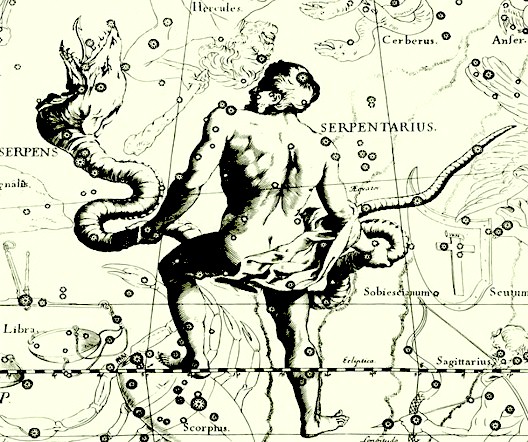
Novidius changed the figure to that of Saint Paul with the Maltese Viper; Caesius gave it as Aaron, whose staff became a serpent, or as Moses, who lifted up the Brazen Serpent in the Wilderness.
The EMS Star of Life, seen on ambulances, features a rod of Asclepius (a blue, six-pointed star, outlined with a white border which features the Rod of Asclepius in the center).

A similar orange star is used for search and rescue personnel and yet another version is used for Wilderness emergency medical technician.

I believe that both the caduceus (2 snakes around a pole with wings at the top) and the rod of Asclepius (1 snake around a pole), both which represent medicine, have their origins from the Bible, when Moses made a staff with a bronze serpent on it, to heal the Israelites.
A similar symbol, Nehushtan, is mentioned in the Bible in Numbers 21:4–9. Attacked by a plague of snakes in the wilderness, Moses holds up a serpent coiled around a staff, both made from bronze, so that the Israelites might recover from the bites. In the Gospel of John, Jesus compared himself to Nehushtan. Jesus taught: "As Moses lifted up the serpent in the wilderness, even so must the Son of Man be lifted up, that whoever believes in Him should not perish but have eternal life".
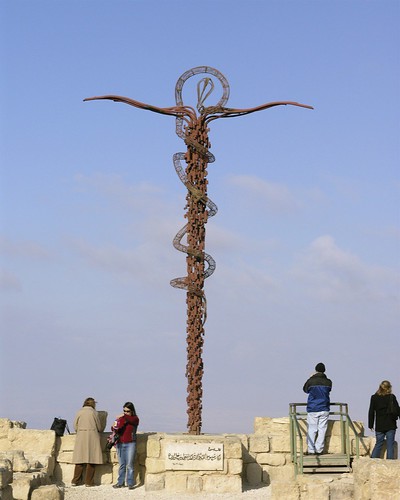

Another interpretation is the wooden rod encoiled by a snake to be representative of the Tree of Knowledge. In the Garden of Eden, the serpent/Satan tempted Eve to eat of the apple, which she also gave to Adam, and thereby brought the 'disease of sin' upon the entire human race, which can only be healed by faith and trust in Christ Jesus, the Messiah.
But the point is, whether you think laminin looks like a cross, a sword, a caduceus, or the rod of Asclepius, ALL of those have biblical symbolism and ties, and so the representation of Christianity and God remain! I can only assume that, since God is the One Who created laminin, He made it look that way intentionally, and the fact is, that no matter which of those items you think it looks like, it still does not detract from the fact that there is Christian and biblical symbolism involved, which apparently seems to be intentional evidence that God placed there!
That same Atheist who posted the sarcastic remark mentioned earlier, also said this:
"Then I spent a little more time and discovered the protein called porin. Porins are the proteins that allow for diffusion of molecules across cell membranes. They are the very mechanism by which our cells receive nourishment! Now wouldn’t you know it, but the porin looks just like the triquetta of Celtic paganism. Yet another expression in creation of how the power of three San Francisco witches feed all of us."
OK, so I looked up 'triquetta.' The triquetra (often, triqueta) is a tripartate symbol composed of three interlocked vesica pisces, marking the intersection of three circles. It is most commonly a symbol of the Holy Trinity (Father, son, Holy spirit) used by the Celtic Christian Church, sometimes stylized as three interlaced fish!

Triplicities were common symbols in Celtic myth and legend, one of the possible reasons Christian beliefs were so easily adopted by the Celtic people.
The triqueta makes an ideal Christian symbol. It is a perfect representation of the concept of "three in one" in Christian trinity beliefs, and incorporates another popular Christian symbol, the fish, in its original form of the vesica pisces. It is sometimes enclosed within a circle to emphasize the unity aspect. The triquetra of interlaced fishes is one of the very earliest of Christian symbols, predating the crucifix by hundreds of years.

So, rather than detracting from the idea that God has placed these evidences within our very cells, this Atheist has unwittingly added to it!
Oh, and by the way, that same Atheist that wrote those sarcastic remarks, writes this later on the same page:
"Do you pray for my soul? Are you saddened to know that I will burn in Hell, or do you think God has a special miraculous plan for me? And what of the billions on Earth who do not believe in the salvation through Christ? Do their damned souls make you weep at night?"
Tuesday, May 20, 2008
Famous Martyrs of the First Century
"Here is a list of eye-witness martyrs as compiled from numerous sources outside the Bible, the most-famous of which is Foxes’ Christian Martyrs of the World:
Stephen was preaching the gospel in Jerusalem on the Passover after Christ’s crucifixion. He was cast out of the city and stoned to death. About 2,000 Christians suffered martyrdom during this time (about 34 A.D.).
James, the son of Zebedee and the elder brother of John, was killed when Herod Agrippa arrived as governor of Judea. Many early disciples were martyred under Agrippa’s rule, including Timon and Parmenas (about 44 A.D.).
Philip, a disciple from Bethsaida, in Galilee, suffered martyrdom at Heliopolis, in Phrygia. He was scourged, thrown into prison, and afterwards crucified (about 54 A.D.).
Matthew, the tax-collector from Nazareth who wrote a gospel in Hebrew, was preaching in Ethiopia when he suffered martyrdom by the sword (about 60 A.D.).
James, the Brother of Jesus, administered the early church in Jerusalem and was the author of a book in the Bible. At the age of 94 he was beat and stoned, and finally had his brains bashed out with a fuller's club.
Matthias was the apostle who filled the vacant place of Judas. He was stoned at Jerusalem and then beheaded.
Andrew, the brother of Peter, preached the gospel throughout Asia. On his arrival at Edessa, he was arrested and crucified on a cross, two ends of which were fixed transversely in the ground (thus the term, St. Andrew's Cross).
Mark was converted to Christianity by Peter, and then transcribed Peter’s account of Jesus in his Gospel. Mark was dragged to pieces by the people of Alexandria in front of Serapis, their pagan idol.
Peter was condemned to death and crucified at Rome. Jerome holds that Peter was crucified upside down, at his own request, because he said he was unworthy to be crucified in the same manner as his Lord.
Paul suffered in the first persecution under Nero. Because of the converting impact he was having on people in the face of martyrdom, he was led to a private place outside the city where he gave his neck to the sword.
Jude, the brother of James, was commonly called Thaddeus. He was crucified at Edessa in about 72 A.D.
Bartholomew translated the Gospel of Matthew in India. He was cruelly beaten and crucified by idolaters there.
Thomas, called Didymus, preached in Parthia and India. He was thrust through with a spear by pagan priests.
Luke was the author of the Gospel under his name. He traveled with Paul through various countries and was supposedly hanged on an olive tree by idolatrous priests in Greece.
Barnabas, of Cyprus, was killed without many known facts about 73 A.D. Simon, surnamed Zelotes, preached in Africa and Britain, where he was crucified in about 74 A.D.
John, the "beloved disciple," was the brother of James. Although he suffered great persecution, including imprisonment where he wrote the book of Revelation, he was the only apostle who escaped a violent death."
from:
http://www.allaboutfollowingjesus.org/voice-of-the-martyrs.htm
Stephen was preaching the gospel in Jerusalem on the Passover after Christ’s crucifixion. He was cast out of the city and stoned to death. About 2,000 Christians suffered martyrdom during this time (about 34 A.D.).
James, the son of Zebedee and the elder brother of John, was killed when Herod Agrippa arrived as governor of Judea. Many early disciples were martyred under Agrippa’s rule, including Timon and Parmenas (about 44 A.D.).
Philip, a disciple from Bethsaida, in Galilee, suffered martyrdom at Heliopolis, in Phrygia. He was scourged, thrown into prison, and afterwards crucified (about 54 A.D.).
Matthew, the tax-collector from Nazareth who wrote a gospel in Hebrew, was preaching in Ethiopia when he suffered martyrdom by the sword (about 60 A.D.).
James, the Brother of Jesus, administered the early church in Jerusalem and was the author of a book in the Bible. At the age of 94 he was beat and stoned, and finally had his brains bashed out with a fuller's club.
Matthias was the apostle who filled the vacant place of Judas. He was stoned at Jerusalem and then beheaded.
Andrew, the brother of Peter, preached the gospel throughout Asia. On his arrival at Edessa, he was arrested and crucified on a cross, two ends of which were fixed transversely in the ground (thus the term, St. Andrew's Cross).
Mark was converted to Christianity by Peter, and then transcribed Peter’s account of Jesus in his Gospel. Mark was dragged to pieces by the people of Alexandria in front of Serapis, their pagan idol.
Peter was condemned to death and crucified at Rome. Jerome holds that Peter was crucified upside down, at his own request, because he said he was unworthy to be crucified in the same manner as his Lord.
Paul suffered in the first persecution under Nero. Because of the converting impact he was having on people in the face of martyrdom, he was led to a private place outside the city where he gave his neck to the sword.
Jude, the brother of James, was commonly called Thaddeus. He was crucified at Edessa in about 72 A.D.
Bartholomew translated the Gospel of Matthew in India. He was cruelly beaten and crucified by idolaters there.
Thomas, called Didymus, preached in Parthia and India. He was thrust through with a spear by pagan priests.
Luke was the author of the Gospel under his name. He traveled with Paul through various countries and was supposedly hanged on an olive tree by idolatrous priests in Greece.
Barnabas, of Cyprus, was killed without many known facts about 73 A.D. Simon, surnamed Zelotes, preached in Africa and Britain, where he was crucified in about 74 A.D.
John, the "beloved disciple," was the brother of James. Although he suffered great persecution, including imprisonment where he wrote the book of Revelation, he was the only apostle who escaped a violent death."
from:
http://www.allaboutfollowingjesus.org/voice-of-the-martyrs.htm
Friday, May 9, 2008
The Resurrection of Jesus - Dr William Lane Craig
The Resurrection of Jesus - Dr William Lane Craig (Part 1)
The Resurrection of Jesus - Dr William Lane Craig (Part 2)
The Resurrection of Jesus - Dr William Lane Craig (Part 3)
The Resurrection of Jesus - Dr William Lane Craig (Part 4)
The Resurrection of Jesus - Dr William Lane Craig (Part 5)
The Resurrection of Jesus - Dr William Lane Craig (Part 2)
The Resurrection of Jesus - Dr William Lane Craig (Part 3)
The Resurrection of Jesus - Dr William Lane Craig (Part 4)
The Resurrection of Jesus - Dr William Lane Craig (Part 5)
Wednesday, May 7, 2008
"Mere Christianity" by C.S. Lewis (parts 25-35)
C.S Lewis - Mere Christianity (Part 25)
C.S Lewis - Mere Christianity (Part 26)
C.S Lewis - Mere Christianity (Part 27)
C.S Lewis - Mere Christianity (Part 28)
C.S Lewis - Mere Christianity (Part 29)
C.S Lewis - Mere Christianity (Part 30)
C.S Lewis - Mere Christianity (Part 31)
C.S Lewis - Mere Christianity (Part 32)
C.S Lewis - Mere Christianity (Part 33)
C.S Lewis - Mere Christianity (Part 34)
C.S Lewis - Mere Christianity (Part 35) Final Part
C.S Lewis - Mere Christianity (Part 26)
C.S Lewis - Mere Christianity (Part 27)
C.S Lewis - Mere Christianity (Part 28)
C.S Lewis - Mere Christianity (Part 29)
C.S Lewis - Mere Christianity (Part 30)
C.S Lewis - Mere Christianity (Part 31)
C.S Lewis - Mere Christianity (Part 32)
C.S Lewis - Mere Christianity (Part 33)
C.S Lewis - Mere Christianity (Part 34)
C.S Lewis - Mere Christianity (Part 35) Final Part
Tuesday, May 6, 2008
"Mere Christianity" by C.S. Lewis (parts 13-24)
C.S Lewis - Mere Christianity (Part 13)
C.S Lewis - Mere Christianity (Part 14)
C.S Lewis - Mere Christianity (Part 15)
C.S Lewis - Mere Christianity (Part 16)
C.S Lewis - Mere Christianity (Part 17)
C.S Lewis - Mere Christianity (Part 18)
C.S Lewis - Mere Christianity (Part 19)
C.S Lewis - Mere Christianity (Part 20)
C.S Lewis - Mere Christianity (Part 21)
C.S Lewis - Mere Christianity (Part 22)
C.S Lewis - Mere Christianity (Part 23)
C.S Lewis - Mere Christianity (Part 24)
C.S Lewis - Mere Christianity (Part 14)
C.S Lewis - Mere Christianity (Part 15)
C.S Lewis - Mere Christianity (Part 16)
C.S Lewis - Mere Christianity (Part 17)
C.S Lewis - Mere Christianity (Part 18)
C.S Lewis - Mere Christianity (Part 19)
C.S Lewis - Mere Christianity (Part 20)
C.S Lewis - Mere Christianity (Part 21)
C.S Lewis - Mere Christianity (Part 22)
C.S Lewis - Mere Christianity (Part 23)
C.S Lewis - Mere Christianity (Part 24)
Monday, May 5, 2008
"Mere Christianity" by C.S. Lewis (parts 1-12)
C.S Lewis - Mere Christianity (Part 1)
C.S Lewis - Mere Christianity (Part 2)
C.S Lewis - Mere Christianity (Part 3)
C.S Lewis - Mere Christianity (Part 4)
C.S Lewis - Mere Christianity (Part 5)
C.S Lewis - Mere Christianity (Part 6)
C.S Lewis - Mere Christianity (Part 7)
C.S Lewis - Mere Christianity (Part 8)
C.S Lewis - Mere Christianity (Part 9)
C.S Lewis - Mere Christianity (Part 10)
C.S Lewis - Mere Christianity (Part 11)
C.S Lewis - Mere Christianity (Part 12)
C.S Lewis - Mere Christianity (Part 2)
C.S Lewis - Mere Christianity (Part 3)
C.S Lewis - Mere Christianity (Part 4)
C.S Lewis - Mere Christianity (Part 5)
C.S Lewis - Mere Christianity (Part 6)
C.S Lewis - Mere Christianity (Part 7)
C.S Lewis - Mere Christianity (Part 8)
C.S Lewis - Mere Christianity (Part 9)
C.S Lewis - Mere Christianity (Part 10)
C.S Lewis - Mere Christianity (Part 11)
C.S Lewis - Mere Christianity (Part 12)
Friday, May 2, 2008
Check out these other blog sites
Here are some cool blog sites to visit:
Please check out my friend Russ' blog site. He blends
humor and theology on his site. He's a great guy, and,
like me, enjoys martial arts:
http://satireandtheology.blogspot.com/
Next is Dan Lacey's site. He is the creator of FaithMouse.
I met him online several months ago on a Christian Forums
site. He's a great guy. He is Catholic, and I am Protestant,
but those differences don't stand in the way of my respect for
him, and the fact that I consider him a friend (even though I
haven't corresponded with him in months):
http://faithmouse.blogspot.com/
I don't know this lady, but her posts really seem to glorify the Lord:
http://praisetotheking.blogspot.com/
Please check out my friend Russ' blog site. He blends
humor and theology on his site. He's a great guy, and,
like me, enjoys martial arts:
http://satireandtheology.blogspot.com/
Next is Dan Lacey's site. He is the creator of FaithMouse.
I met him online several months ago on a Christian Forums
site. He's a great guy. He is Catholic, and I am Protestant,
but those differences don't stand in the way of my respect for
him, and the fact that I consider him a friend (even though I
haven't corresponded with him in months):
http://faithmouse.blogspot.com/
I don't know this lady, but her posts really seem to glorify the Lord:
http://praisetotheking.blogspot.com/
Sunday, April 27, 2008
Christianity, the Arts and the Martial Arts
Man was created in the image of God. God is the original Creator of all things. God also loves beauty (as evidenced in His Creation). Man, too, was given the ability to create. Man was created to glorify God and serve Him. However, some churches seem to think that Art and Drama are not legitimate for a Christian to partake in, unless they have an obvious 'religious' connotation to them. For example, drawing pictures is OK only if it is used to create something like a gospel tract; or, Drama is OK only if it is used to accurately depict something from the Bible. And I would agree that both Art and Drama have been used, at times, to depict things that are ungodly, or even perverted; or even have gone so far as to explicitly mock Jesus. Yet, I think most of the time, Art has been used simply to depict people, or things in nature; and Drama has been used largely to depict interaction between people, whether it be something historical, or something fictional.
Therefore, for a Christian (or a church) to say that Art or Drama for their own sake are not legitimate or appropriate for a Christian, unless they are 'spiritualized' by having direct 'religious' connotations, is to deny the fact that different people are given different talents by God, and that people create things because they were made in the image of a God Who created the heavens and the earth. And for a church to imply that a person's gifts or talents are not legitimate or appropriate unless those gifts or talents are used within a church service, or to promote the church, or to help with the building and upkeep of the church, is to have a far-too-narrow view of people's God-given gifts and talents.
For example, some Christians might not think too highly of my using Photoshop to create something such as this:
Original photo of me in 7th Grade:

The same photo after doing some things to it in Adobe Photoshop CS2:

In addition, some Christians think that the martial arts are evil and inappropriate for a Christian---either because they promote violence, or because they are rooted in Eastern Religions. When I first asked Jesus to come into my 'heart' and take over my life at 19 years of age, I immediately gave up weight-training and karate. Why? Because they were the 'gods' in my life. In other words, they held the priorities in my life. Years later, the Lord allowed me to get back into weight-training and martial arts---just without having them as priorities in my life. He doesn't want to take away our fun and enjoyment; He simply wants us to put Him first.
I find it interesting and ironic that some of those Christians that are so opposed to martial arts are strong advocates of owning a gun; while I, on the other hand, would not want to own a gun, because I hate guns, and I hate the thought of shooting a human being with a gun.
Tuesday, April 22, 2008
Sunday, April 20, 2008
Saturday, April 19, 2008
I've always liked this quote
"Going to church doesn't make you any more a Christian than going to the garage makes you a car."
-Laurence J. Peter
I have also always like the following quote, ever since I heard it, years ago:
"A man convinced against his will, is of the same opinion still."
-unknown
There are similar quotes to this one as well, including the following:
"A man convinced against his will is not convinced."
-Laurence J. Peter
"He that complies against his will
Is of his own opinion still. "
~Samuel Butler, in Hudibras (Part iii. Canto iii. Line 547)
-Laurence J. Peter
I have also always like the following quote, ever since I heard it, years ago:
"A man convinced against his will, is of the same opinion still."
-unknown
There are similar quotes to this one as well, including the following:
"A man convinced against his will is not convinced."
-Laurence J. Peter
"He that complies against his will
Is of his own opinion still. "
~Samuel Butler, in Hudibras (Part iii. Canto iii. Line 547)
Saturday, April 5, 2008
Friday, April 4, 2008
Wednesday, April 2, 2008
Lee Strobel's Testimony
This is a short summary of Lee Strobel's testimony. He is a former atheist, lawyer and award-winning legal editor of the Chicago Tribune who decided to use his legal and journalistic training to investigate the claims of Christianity and see if there was any credibility to it. He decided to do what he did at the Chicago Tribune, which was to check out stories to see if they were true. He decided to look at both sides, as well as looking at other world religions. In addition, he looked at some of the most brilliant legal minds of history; for example, Simon Greenleaf of Harvard, and Sir Lionel Luckhoo, of whom the Guinness Book of World Records describes as the most successful lawyer in the history of the world (he had more murder trials won in a row than any other defense attorney in history). These men were brilliant people who applied the laws of evidence to the resurrection accounts and walked away convinced that they are true. After almost 2 years of intense investigation, Lee concluded that the evidence overwhelmingly supported the claims of Christianity.
Monday, March 31, 2008
Former Gay Hairdresser to the Stars accepts Christ
This is the testimony of former homosexual Danny Velasco, who was a famous and succesful hairdresser and had a salon visted by the elite of Hollywood. Danny passed away on 10/04/2007.
Sunday, March 30, 2008
Old Testament salvation
Some people tend to think that, in the Old Testament, people were saved by obeying the Ten Commandments (i.e., by works) and in the New Testament, people are saved by believing in Jesus (i.e., by faith).
And yet, Hebrews 11 states that those in the Old Testament were actually saved by faith. They believed God and looked forward to the coming of the promised Messiah:
“Now faith is being sure of what we hope for and certain of what we do not see. This is what the ancients were commended for. By faith we understand that the universe was formed at God's command, so that what is seen was not made out of what was visible.
By faith Abel offered God a better sacrifice than Cain did. By faith he was commended as a righteous man, when God spoke well of his offerings. And by faith he still speaks, even though he is dead.
By faith Enoch was taken from this life, so that he did not experience death; he could not be found, because God had taken him away. For before he was taken, he was commended as one who pleased God. And without faith it is impossible to please God, because anyone who comes to him must believe that he exists and that he rewards those who earnestly seek him.
By faith Noah, when warned about things not yet seen, in holy fear built an ark to save his family. By his faith he condemned the world and became heir of the righteousness that comes by faith.
By faith Abraham, when called to go to a place he would later receive as his inheritance, obeyed and went, even though he did not know where he was going. By faith he made his home in the promised land like a stranger in a foreign country; he lived in tents, as did Isaac and Jacob, who were heirs with him of the same promise. For he was looking forward to the city with foundations, whose architect and builder is God. By faith Abraham, even though he was past age—and Sarah herself was barren—was enabled to become a father because he considered him faithful who had made the promise. And so from this one man, and he as good as dead, came descendants as numerous as the stars in the sky and as countless as the sand on the seashore.
All these people were still living by faith when they died. They did not receive the things promised; they only saw them and welcomed them from a distance. And they admitted that they were aliens and strangers on earth. People who say such things show that they are looking for a country of their own. If they had been thinking of the country they had left, they would have had opportunity to return. Instead, they were longing for a better country—a heavenly one. Therefore God is not ashamed to be called their God, for he has prepared a city for them.
By faith Abraham, when God tested him, offered Isaac as a sacrifice. He who had received the promises was about to sacrifice his one and only son, even though God had said to him, "It is through Isaac that your offspring will be reckoned." Abraham reasoned that God could raise the dead, and figuratively speaking, he did receive Isaac back from death.
By faith Isaac blessed Jacob and Esau in regard to their future. By faith Jacob, when he was dying, blessed each of Joseph's sons, and worshiped as he leaned on the top of his staff.
By faith Joseph, when his end was near, spoke about the exodus of the Israelites from Egypt and gave instructions about his bones.
By faith Moses' parents hid him for three months after he was born, because they saw he was no ordinary child, and they were not afraid of the king's edict. By faith Moses, when he had grown up, refused to be known as the son of Pharaoh's daughter. He chose to be mistreated along with the people of God rather than to enjoy the pleasures of sin for a short time. He regarded disgrace for the sake of Christ as of greater value than the treasures of Egypt, because he was looking ahead to his reward. By faith he left Egypt, not fearing the king's anger; he persevered because he saw him who is invisible. By faith he kept the Passover and the sprinkling of blood, so that the destroyer of the firstborn would not touch the firstborn of Israel. By faith the people passed through the Red Sea as on dry land; but when the Egyptians tried to do so, they were drowned.
By faith the walls of Jericho fell, after the people had marched around them for seven days.
By faith the prostitute Rahab, because she welcomed the spies, was not killed with those who were disobedient.
And what more shall I say? I do not have time to tell about Gideon, Barak, Samson, Jephthah, David, Samuel and the prophets, who through faith conquered kingdoms, administered justice, and gained what was promised; who shut the mouths of lions, quenched the fury of the flames, and escaped the edge of the sword; whose weakness was turned to strength; and who became powerful in battle and routed foreign armies. Women received back their dead, raised to life again. Others were tortured and refused to be released, so that they might gain a better resurrection. Some faced jeers and flogging, while still others were chained and put in prison. They were stoned; they were sawed in two; they were put to death by the sword. They went about in sheepskins and goatskins, destitute, persecuted and mistreated—the world was not worthy of them. They wandered in deserts and mountains, and in caves and holes in the ground. These were all commended for their faith, yet none of them received what had been promised. God had planned something better for us so that only together with us would they be made perfect.”
Even Genesis says that Abraham was declared righteous (holy) by faith:
“Abram believed the LORD, and he credited it to him as righteousness.” (Gen. 15:6)
Modern evangelists have often used verses from the book of Romans to illustrate the way to salvation, in what they call “The Romans Road.” Typically, it usually goes something like this:
1. We must acknowledge God as the Creator of everything, accepting our humble position in God's created order and purpose.
Romans 1:20-21:
"For since the creation of the world His invisible attributes are clearly seen, being understood by the things that are made, even His eternal power and Godhead, so that they are without excuse, because, although they knew God, they did not glorify Him as God, nor were thankful, but became futile in their thoughts, and their foolish hearts were darkened."
2. We must realize that we are sinners and that we need forgiveness. None of us are worthy under God’s standards.
Romans 3:23:
“For all have sinned, and fall short of the glory of God.”
3. God gave us the way to be forgiven of our sins. He showed us His love by giving us the potential for life through the death of His Son, Jesus Christ.
Romans 5:8:
“But God demonstrates His love toward us, in that, while we were still sinners, Christ died for us.”
4. If we remain sinners, we will die. However, if we repent of our sins, and accept Jesus Christ as our Lord and Savior, we will have eternal life.
Romans 6:23:
“For the wages of sin is death, but the gift of God is eternal life in Christ Jesus our Lord.”
5. Confess that Jesus Christ is Lord and believe in your heart that God raised Him from the dead and you are saved.
Romans 10:9-10:
“That if you confess with your mouth the Lord Jesus and believe in your heart that God has raised Him from the dead, you will be saved. For with the heart one believes unto righteousness, and with the mouth confession is made unto salvation.”
6. There are no other religious formulas or rituals. Just call upon the name of the Lord and you will be saved!
Romans 10:13:
“For whoever calls on the name of the LORD shall be saved.”
7. Determine in your heart to make Jesus Christ the Lord of your life today.
Romans 11:36:
"For of Him and through Him and to Him are all things, to whom be glory forever. Amen."
And yet, I think that not many people realize that the Old Testament teaches the same basic principles:
No one does good; not even one:
“The LORD looks down from heaven on the sons of men to see if there are any who understand, any who seek God. All have turned aside, they have together become corrupt; there is no one who does good, not even one.” (Psalm 14:2-3)
We are sinful at birth:
“Surely I was sinful at birth, sinful from the time my mother conceived me.” (Psalm 51:5)
The heart is deceitful above all things (i.e., we are sinners):
“The heart is deceitful above all things and beyond cure. Who can understand it?” (Jeremiah 17:9)
Unclean lips (i.e., we are sinners in need of forgiveness):
"Woe to me!" I cried. "I am ruined! For I am a man of unclean lips, and I live among a people of unclean lips, and my eyes have seen the King, the LORD Almighty." (Isaiah 6:5)
In contrast to those who think they are “good,” the Bible says that even the best ‘good deeds’ we do (our “righteous acts”) are like filthy rags (in the original language, the term means a woman’s menstruating rags) compared to God’s holiness:
“All of us have become like one who is unclean, and all our righteous acts are like filthy rags; we all shrivel up like a leaf, and like the wind our sins sweep us away.” (Isaiah 64:6)
God will blot out sinners from His book:
“The LORD replied to Moses, "Whoever has sinned against me I will blot out of my book.” (Exodus 32:33)
There was no sacrifice for willful sins:
"But anyone who sins defiantly, whether native-born or alien, blasphemes the LORD, and that person must be cut off from his people. Because he has despised the LORD's word and broken his commands, that person must surely be cut off; his guilt remains on him." (Numbers 15:30-31)
Prayer to blot out our iniquity (sin):
“Hide your face from my sins and blot out all my iniquity.” (Psalm 51:9)
King David cried out to God for mercy:
“Have mercy on me, O God, according to your unfailing love; according to your great compassion blot out my transgressions.” (Psalm 51:1 [and the rest of Psalm 51])
Isaiah, the Old Testament prophet, was saved by God’s mercy:
“With it he touched my mouth and said, "See, this has touched your lips; your guilt is taken away and your sin atoned for." (Isaiah 6:7)
Sins were forgiven by a blood sacrifice:
“For the life of a creature is in the blood, and I have given it to you to make atonement for yourselves on the altar; it is the blood that makes atonement for one's life.” (Leviticus 17:11)
Jews no longer practice animal sacrifice, and Christians never practiced animal sacrifice. In fact, the first Jewish temple (where sacrifices were performed) was destroyed for 70 years because of Israel’s disobedience, and the second temple was destroyed about 40 years after Jesus’ death (this also means that the Jewish genealogies have been lost, so that no one can claim that their lineage goes back to King David, and therefore cannot rightfully claim that they are the Messiah…the only Jewish genealogy we have left today is that of Jesus; we have both His maternal and His paternal genealogy; and His lineage DOES go back to King David, which is one requirement of the promised Messiah).
Christ Jesus’ death on the cross was the final, ultimate sacrifice for sins. For all who are believers, Christ Jesus is the ultimate and perfect High Priest. No other sacrifice for sins is needed, for Jesus has fulfilled all of that in Himself.
And yet, Hebrews 11 states that those in the Old Testament were actually saved by faith. They believed God and looked forward to the coming of the promised Messiah:
“Now faith is being sure of what we hope for and certain of what we do not see. This is what the ancients were commended for. By faith we understand that the universe was formed at God's command, so that what is seen was not made out of what was visible.
By faith Abel offered God a better sacrifice than Cain did. By faith he was commended as a righteous man, when God spoke well of his offerings. And by faith he still speaks, even though he is dead.
By faith Enoch was taken from this life, so that he did not experience death; he could not be found, because God had taken him away. For before he was taken, he was commended as one who pleased God. And without faith it is impossible to please God, because anyone who comes to him must believe that he exists and that he rewards those who earnestly seek him.
By faith Noah, when warned about things not yet seen, in holy fear built an ark to save his family. By his faith he condemned the world and became heir of the righteousness that comes by faith.
By faith Abraham, when called to go to a place he would later receive as his inheritance, obeyed and went, even though he did not know where he was going. By faith he made his home in the promised land like a stranger in a foreign country; he lived in tents, as did Isaac and Jacob, who were heirs with him of the same promise. For he was looking forward to the city with foundations, whose architect and builder is God. By faith Abraham, even though he was past age—and Sarah herself was barren—was enabled to become a father because he considered him faithful who had made the promise. And so from this one man, and he as good as dead, came descendants as numerous as the stars in the sky and as countless as the sand on the seashore.
All these people were still living by faith when they died. They did not receive the things promised; they only saw them and welcomed them from a distance. And they admitted that they were aliens and strangers on earth. People who say such things show that they are looking for a country of their own. If they had been thinking of the country they had left, they would have had opportunity to return. Instead, they were longing for a better country—a heavenly one. Therefore God is not ashamed to be called their God, for he has prepared a city for them.
By faith Abraham, when God tested him, offered Isaac as a sacrifice. He who had received the promises was about to sacrifice his one and only son, even though God had said to him, "It is through Isaac that your offspring will be reckoned." Abraham reasoned that God could raise the dead, and figuratively speaking, he did receive Isaac back from death.
By faith Isaac blessed Jacob and Esau in regard to their future. By faith Jacob, when he was dying, blessed each of Joseph's sons, and worshiped as he leaned on the top of his staff.
By faith Joseph, when his end was near, spoke about the exodus of the Israelites from Egypt and gave instructions about his bones.
By faith Moses' parents hid him for three months after he was born, because they saw he was no ordinary child, and they were not afraid of the king's edict. By faith Moses, when he had grown up, refused to be known as the son of Pharaoh's daughter. He chose to be mistreated along with the people of God rather than to enjoy the pleasures of sin for a short time. He regarded disgrace for the sake of Christ as of greater value than the treasures of Egypt, because he was looking ahead to his reward. By faith he left Egypt, not fearing the king's anger; he persevered because he saw him who is invisible. By faith he kept the Passover and the sprinkling of blood, so that the destroyer of the firstborn would not touch the firstborn of Israel. By faith the people passed through the Red Sea as on dry land; but when the Egyptians tried to do so, they were drowned.
By faith the walls of Jericho fell, after the people had marched around them for seven days.
By faith the prostitute Rahab, because she welcomed the spies, was not killed with those who were disobedient.
And what more shall I say? I do not have time to tell about Gideon, Barak, Samson, Jephthah, David, Samuel and the prophets, who through faith conquered kingdoms, administered justice, and gained what was promised; who shut the mouths of lions, quenched the fury of the flames, and escaped the edge of the sword; whose weakness was turned to strength; and who became powerful in battle and routed foreign armies. Women received back their dead, raised to life again. Others were tortured and refused to be released, so that they might gain a better resurrection. Some faced jeers and flogging, while still others were chained and put in prison. They were stoned; they were sawed in two; they were put to death by the sword. They went about in sheepskins and goatskins, destitute, persecuted and mistreated—the world was not worthy of them. They wandered in deserts and mountains, and in caves and holes in the ground. These were all commended for their faith, yet none of them received what had been promised. God had planned something better for us so that only together with us would they be made perfect.”
Even Genesis says that Abraham was declared righteous (holy) by faith:
“Abram believed the LORD, and he credited it to him as righteousness.” (Gen. 15:6)
Modern evangelists have often used verses from the book of Romans to illustrate the way to salvation, in what they call “The Romans Road.” Typically, it usually goes something like this:
1. We must acknowledge God as the Creator of everything, accepting our humble position in God's created order and purpose.
Romans 1:20-21:
"For since the creation of the world His invisible attributes are clearly seen, being understood by the things that are made, even His eternal power and Godhead, so that they are without excuse, because, although they knew God, they did not glorify Him as God, nor were thankful, but became futile in their thoughts, and their foolish hearts were darkened."
2. We must realize that we are sinners and that we need forgiveness. None of us are worthy under God’s standards.
Romans 3:23:
“For all have sinned, and fall short of the glory of God.”
3. God gave us the way to be forgiven of our sins. He showed us His love by giving us the potential for life through the death of His Son, Jesus Christ.
Romans 5:8:
“But God demonstrates His love toward us, in that, while we were still sinners, Christ died for us.”
4. If we remain sinners, we will die. However, if we repent of our sins, and accept Jesus Christ as our Lord and Savior, we will have eternal life.
Romans 6:23:
“For the wages of sin is death, but the gift of God is eternal life in Christ Jesus our Lord.”
5. Confess that Jesus Christ is Lord and believe in your heart that God raised Him from the dead and you are saved.
Romans 10:9-10:
“That if you confess with your mouth the Lord Jesus and believe in your heart that God has raised Him from the dead, you will be saved. For with the heart one believes unto righteousness, and with the mouth confession is made unto salvation.”
6. There are no other religious formulas or rituals. Just call upon the name of the Lord and you will be saved!
Romans 10:13:
“For whoever calls on the name of the LORD shall be saved.”
7. Determine in your heart to make Jesus Christ the Lord of your life today.
Romans 11:36:
"For of Him and through Him and to Him are all things, to whom be glory forever. Amen."
And yet, I think that not many people realize that the Old Testament teaches the same basic principles:
No one does good; not even one:
“The LORD looks down from heaven on the sons of men to see if there are any who understand, any who seek God. All have turned aside, they have together become corrupt; there is no one who does good, not even one.” (Psalm 14:2-3)
We are sinful at birth:
“Surely I was sinful at birth, sinful from the time my mother conceived me.” (Psalm 51:5)
The heart is deceitful above all things (i.e., we are sinners):
“The heart is deceitful above all things and beyond cure. Who can understand it?” (Jeremiah 17:9)
Unclean lips (i.e., we are sinners in need of forgiveness):
"Woe to me!" I cried. "I am ruined! For I am a man of unclean lips, and I live among a people of unclean lips, and my eyes have seen the King, the LORD Almighty." (Isaiah 6:5)
In contrast to those who think they are “good,” the Bible says that even the best ‘good deeds’ we do (our “righteous acts”) are like filthy rags (in the original language, the term means a woman’s menstruating rags) compared to God’s holiness:
“All of us have become like one who is unclean, and all our righteous acts are like filthy rags; we all shrivel up like a leaf, and like the wind our sins sweep us away.” (Isaiah 64:6)
God will blot out sinners from His book:
“The LORD replied to Moses, "Whoever has sinned against me I will blot out of my book.” (Exodus 32:33)
There was no sacrifice for willful sins:
"But anyone who sins defiantly, whether native-born or alien, blasphemes the LORD, and that person must be cut off from his people. Because he has despised the LORD's word and broken his commands, that person must surely be cut off; his guilt remains on him." (Numbers 15:30-31)
Prayer to blot out our iniquity (sin):
“Hide your face from my sins and blot out all my iniquity.” (Psalm 51:9)
King David cried out to God for mercy:
“Have mercy on me, O God, according to your unfailing love; according to your great compassion blot out my transgressions.” (Psalm 51:1 [and the rest of Psalm 51])
Isaiah, the Old Testament prophet, was saved by God’s mercy:
“With it he touched my mouth and said, "See, this has touched your lips; your guilt is taken away and your sin atoned for." (Isaiah 6:7)
Sins were forgiven by a blood sacrifice:
“For the life of a creature is in the blood, and I have given it to you to make atonement for yourselves on the altar; it is the blood that makes atonement for one's life.” (Leviticus 17:11)
Jews no longer practice animal sacrifice, and Christians never practiced animal sacrifice. In fact, the first Jewish temple (where sacrifices were performed) was destroyed for 70 years because of Israel’s disobedience, and the second temple was destroyed about 40 years after Jesus’ death (this also means that the Jewish genealogies have been lost, so that no one can claim that their lineage goes back to King David, and therefore cannot rightfully claim that they are the Messiah…the only Jewish genealogy we have left today is that of Jesus; we have both His maternal and His paternal genealogy; and His lineage DOES go back to King David, which is one requirement of the promised Messiah).
Christ Jesus’ death on the cross was the final, ultimate sacrifice for sins. For all who are believers, Christ Jesus is the ultimate and perfect High Priest. No other sacrifice for sins is needed, for Jesus has fulfilled all of that in Himself.
Wednesday, March 26, 2008
Saturday, March 22, 2008
The greatest act of love
God created us. We disobeyed and rebelled and turned away from Him. The creation mutinied like a crew against its Captain; sinned and turned against its holy, righteous Creator. We broke God's Law (the 10 Commandments) and we continue to break His Law daily...not only outwardly, but inwardly as well. God is a righteous Judge, and He says that all sin must be punished. Not only that, but God cannot allow wickedness, selfishness, pride and sin into Heaven. But we cannot be holy and perfect and sinless like God is. Rather than send all humans to Hell, however, God the Father sent God the Son to die for us...to pay the penalty for our sins...to take our place...so that anyone who comes to Christ can be forgiven. God paid the price for us, that we could never pay ourselves. All we have to do is repent of (turn away from) our sins and follow Him. If we sincerely reject our sins and accept Him, asking Him to forgive us and to come into our life and make us brand new, He will. All we have to do is accept Him and follow Him. He offers us His love; all we have to do is accept it.
Watch this powerful and moving video about God's love:
Watch this powerful and moving video about God's love:
Subscribe to:
Posts (Atom)


 Posts
Posts


